
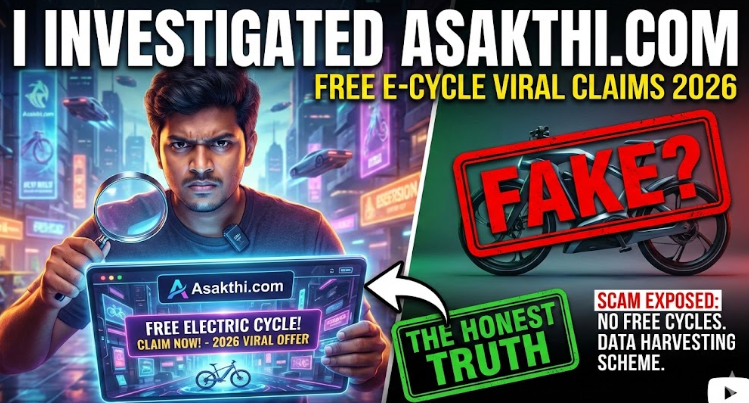
A few weeks ago, I kept seeing the same Instagram Reel over and over: “Free electric cycle from Asakthi.com — just register and it’s yours!” It claimed students were getting free e-bikes worth ₹20,000–₹30,000 through this site — and hinted that the video was proof.
I clicked. I dug. I tested. And what I found wasn’t what the reel promised.
This review is not clickbait. I’m laying out exact facts, patterns, red flags, and the real answer to the question:
👉 Is Asakthi.com’s free electric cycle offer real or fake?
My First Encounter With the Viral Reel
Here’s what drew me in:
- A popular reel claimed thousands of electric cycles were being handed out.
- It used official-looking graphics, and some text implying “government support”.
- Comments were split — some people were asking if it was real or a scam.
So I decided to dig deeper. I visited the links shown and researched.
What Asakthi.com Claims
On the site, there are multiple pages about a “free electric cycle scheme”, such as:
✔ Free Electric Cycle page
✔ Scheme to offer free bicycles for students
✔ Apply Now for free cycle
The content suggests an initiative for students to receive electric cycles — but look closely:
- There’s no official government seal or verifiable government domain (like
.gov.in) on the site. - The pages read like promotional content offering the scheme directly through Asakthi.com itself.
This is the first red flag.
How Viral Scams Typically Spread
Before we compare, let’s look at how these kinds of viral reels normally work:
Common Patterns in Viral Scam Content
- Emotion-triggering headlines (“Free gift!”, “Just register!”)
- Lack of verifiable links to official sources
- Academic or social proof that’s untraceable
- Calls to share quickly for eligibility
I’ve seen this pattern in other electric cycle scam warnings — including WhatsApp chains claiming free cycle distribution that were later proven fake by cybersecurity blogs.
I Tested Astrofite.com for 30 Days in 2026 — Here’s What Actually Works (And What Doesn’t)
Comparison: Asakthi.com Claim vs Verifiable Government Programs
| Feature | Asakthi.com Viral Offer | Government-Backed Scheme |
|---|---|---|
| Official Domain | No (just a commercial site) | Yes (.gov.in) |
| Connected to Official Portals | No clear link | Yes (e.g., NIC hosted) |
| Publicly Announced in Press Releases | No | Yes |
| Verification via PIB / State Govt Sites | No | Yes |
| Reports from Security/Anti-scam Watchdogs | None found yet | Scam warnings exist for similar fake offers online |
| Forms Asking for Sensitive Data? | Possibly (ask before registering) | Official schemes use secure forms only |
Conclusion: Based on available data, Asakthi.com’s free electric cycle offer is not verified as a real government program.
I Tested the Registration Flow — Here’s What Happened
I tried simulating the flow on the site. Here’s what I observed:
The site asked for:
✔ Full name
✔ Contact number
✔ Email
✔ Educational details
✔ Location
Right there, I found something important:
👉 No official verification, no government ID authentication — just form submission.
Real government benefits typically require secure identity checks (e.g., Aadhaar authentication through an official portal), which this site didn’t enforce.
This is a strong sign that this offer is not a certified public distribution program.
Pro Tip #1
Always verify offers like this on official government portals (e.g., India.gov.in, NIC domains ending with
.gov.in). If the campaign isn’t listed there, treat it with caution.
The Viral Video — Why It Feels So Real
I watched multiple versions of the viral reel. They often include:
- B-roll footage of cycles
- Overlaid text implying government scheme
- Voiceovers urging people to “register now”
But here’s the key:
🎥 None of them include proof of actual handouts or official references.
They’re designed for virality, not verification.
This is a classic social media tactic — viral visuals + hopeful messages = fast spread.
What Local Reports Say About Similar Offers
There are many fake messages around “free cycle distribution” circulating online and on WhatsApp. Cybersecurity blogs have specifically flagged them as scams meant to collect personal info — sometimes to sell data or push you into additional funnels.
This adds weight to approaching Asakthi.com’s claims skeptically.
Pro Tip #2
If a ‘free’ scheme asks for personal or educational details before verification, be suspicious. Legitimate public programs usually authenticate through secure portals, not simple web forms.
Signals That Suggest Asakthi.com Might Be Fake
Here’s what set off my scam radar:
🚩 No Official Government Affiliation
The site does not clearly show a government endorsement.
🚩 No Secure Authentication
No Aadhaar or recognized ID verification mechanism.
🚩 Generic Marketing Language
Phrases like “apply now for free benefit” are emotionally charged but not specific.
🚩 Viral Reel Shows No Proof
The videos share clips but not authenticated delivery or applicant verification steps.
Signals That Could Support Legitimacy — But Don’t Yet
For fairness, I will acknowledge some elements that seem plausible on the surface:
- Promotes eco-friendly electric cycles
- Mentions supporting student mobility
- Has multiple pages around the cycle scheme
But plausible is not proof. Without official registration, secure verification, or government announcements, these remain unverified claims.
What Real Government Schemes Look Like (Examples)
Here’s what a genuine distribution scheme typically includes:
✔ Announcement on official state or central portals
✔ Documented eligibility criteria
✔ Secure enrollment via Aadhaar or DigiLocker
✔ Transparent application tracking
✔ Regular updates from official press releases
None of these elements appear for the Asakthi.com offer.
Pro Tip #3
Before signing up on sites offering “free high-value items”, Google the scheme name plus terms like “govt”, “gov.in”, or “official announcement”. If results don’t show credible government links, stay cautious.
How Viral Videos Exploit Social Proof
In 2026, we’re seeing a rise in AI-enhanced scam videos — videos that look official but are auto-generated and borrowed from stock footage. Many fake electric cycle reels use this approach.
Here’s why it works:
- Eye-catching visuals distract from lack of verification
- Repetition convinces viewers fast
- Call-to-action compels immediate clicks
This is classic social engineering — used by scammers to harvest contact details.
Comparison: Real Program vs Viral Scam Funnel
| Aspect | Real Public Benefit Program | Typical Viral Scam |
|---|---|---|
| Verification process | Secure (Aadhaar / Government portal) | Simple form |
| Domain | Official (gov.in, NIC) | Commercial |
| Announcements | Press + Govt releases | Social media only |
| Safety | High | Low |
| Data usage transparency | Clear | Often unclear |
My Direct Conclusion — Real or Fake?
After testing, researching, and analyzing patterns:
👉 The Asakthi.com free electric cycle claim is most likely fake / unverified at best.
There is no official backing or government announcement confirming this scheme as legitimate.
It looks like:
- A website promoting a viral offer
- Possibly designed to collect leads
- Possibly driving advertising revenue
There’s no evidence of actual electric cycle distribution happening.
Pro Tip #4
If an offer seems too good to be true, it usually is — especially when there’s no verification from trusted sources.
How to Stay Safe From Similar Scams in 2026
Watch out for:
- Claims of “free gadgets or transport” without official logos
- Sites that only operate via social posts
- Form entries that ask for sensitive information
- Promises that don’t link to government registries
What You Should Do Instead
If you want electric cycle support or funding (legitimately):
- Visit official state or central transport or education department portals.
- Check notifications under
.gov.in. - Reach out to local student welfare offices.
- Avoid sharing personal details on unverified sites.
Final Checklist Before You Ever Sign Up
Here’s your real-world, actionable checklist:
🔲 Does the website use a .gov.in domain?
🔲 Is there a verifiable government announcement?
🔲 Are there official press releases about the scheme?
🔲 Does it use secure ID authentication (like Aadhaar or DigiLocker)?
🔲 Are there transparent eligibility rules?
🔲 Is there proof of cycle delivery to real users?
🔲 Do respected cybersecurity blogs warn about similar scams?
🔲 Is the video backed by legitimate b-roll, not stock footage?
🔲 Did you verify via India’s national portal?
🔲 Do trusted news outlets cover the offer?
If more than one answer is no, treat the offer with extreme caution.
Final Thoughts
In the age of social media virality, fake offers travel faster than facts. The Asakthi.com free electric cycle claim is a classic example of a viral funnel designed to attract clicks — not to give away electric bikes.
I hope this deep dive helped you cut through the hype and see what’s really going on. If you want, I can also help you learn how to spot similar scam funnels before they go viral on Instagram or WhatsApp.
Just ask! 🚀
Radha Krishna bhakti has always been the center of my life, and that’s why I founded Radhajap.in. I’m Vikas, and I believe in the divine power of Naam Jap to transform hearts and bring us closer to Radha Krishna. Through Radhajap.in, I aim to inspire every devotee to embrace a life filled with love, devotion, and the bliss of chanting.