
I remember the first time someone asked me this question.
It was a young boy, maybe ten years old, at a small satsang in our neighbourhood. The kirtan had just ended. The panditji was distributing prasad. And this boy, completely out of nowhere, tugged at his mother’s dupatta and asked loudly:
“Maa, why do we always say Radhe Krishna? Why not Krishna Radhe? Krishna is Bhagwan — shouldn’t His name come first?”
The room went quiet for a moment. A few people smiled. And the panditji — instead of giving a quick answer — put down the prasad, sat back down, and said:
“Beta, this is one of the most beautiful questions in all of bhakti. Sit.”
What followed was a 20-minute explanation that I have carried with me ever since. This post is my attempt to share that understanding — along with everything I have learned since that evening.
Because the answer is not just a tradition. It is a window into the very heart of Vaishnavism.
Best Day of the Week for Naam Jap According to Your Rashi
First — Is It Actually Always Radha Before Krishna?
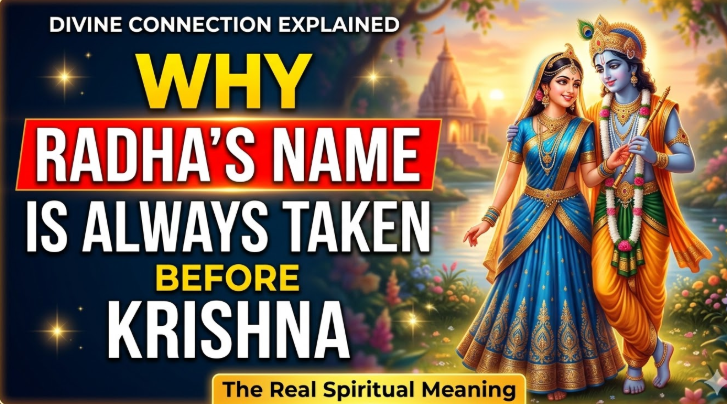
Yes. And this is not accidental, not regional, and not just a poetic preference.
Across North India, in Vrindavan temples, in Braj folk traditions, in the writings of the Ashtachhap poets, in the bhajans of Mirabai and Surdas — the name Radha almost always precedes Krishna.
We say: Radhe Krishna. Radhe Shyam. Radhe Govind. Hare Radhe Hare Krishna.
Even the great saint Chaitanya Mahaprabhu — who is considered by many Vaishnavas to be a combined avatar of Radha and Krishna — gave primacy to Radha’s name in his teachings. His most famous instruction was simply: chant the name of Radha.
So why? Let us go through the real reasons — not the surface ones.
Reason 1 — Radha Is the Shakti. Krishna Is the Shaktimaan.
In Vedic philosophy, every divine being has two aspects: Shakti (the power, the energy) and Shaktimaan (the one who holds that power).
Without Shakti, the Shaktimaan cannot act. Cannot create. Cannot love.
Radha is Krishna’s Shakti — His inner divine energy, His hlaadinishakti (the power of divine bliss). Without Radha, Krishna is complete in Himself, yes — but His love has no expression, no movement, no sweetness.
It is like the sun and its light. You can speak of the sun — but the sun’s existence is only known to us because of its light. The light reaches us first.
Radha is the light that makes Krishna knowable to a devotee. This is why Her name is spoken first — She is the door through which we enter into Krishna’s presence.
The ancient Narada Pancharatra says this explicitly: it is Radha who grants access to Krishna. She is the gateway. Speaking Her name first is not a mark of greater importance — it is the recognition of how the path works.
Reason 2 — The Principle of the Guru
In every spiritual tradition, the guru’s name is taken before the deity’s name. The guru is the one who shows you the way. The guru makes the divine accessible to a student who might otherwise never find the path.
In Radha-Krishna bhakti, Radha is considered the param guru — the original teacher of love. She does not just love Krishna. She is the very definition of how to love the divine. Her bhakti is the standard, the model, the pinnacle.
When a devotee says ‘Radhe Krishna,’ they are first invoking the teacher and then the taught — first the path and then the destination. This is both reverence and wisdom.
The saints of Vrindavan say: if you want to reach Krishna, first hold Radha’s hand. She will take you there. No effort on your part can bring you to Krishna faster than Her grace can.
Reason 3 — Radha Represents the Devotee’s Soul
Here is the deepest explanation — and the one that the panditji gave that evening that made the whole room go still.
In the philosophy of Radha-Krishna bhakti, every soul (jeeva) is feminine in relation to the divine. Krishna is the one supreme male principle — the Purush. Every soul, regardless of the physical body it inhabits, is in the position of a beloved in relation to Krishna.
Radha is the soul at its most perfected state — a jeeva that has completely dissolved into divine love, that has no separate desire, no separate will, only complete surrender and complete union with the divine.
When you say ‘Radhe Krishna,’ you are saying: ‘May I — like Radha — one day stand before You. May my love be even a fraction of Hers. Take me to You as She is with You.’
Her name before His is a prayer embedded in a name. It is the devotee saying: I want what She has. Bring me to where She is.
This is not just philosophy. Anyone who has sat in deep jap of ‘Radhe Radhe’ will tell you — at some point, the name stops being two syllables you are repeating and becomes a longing. A reaching. A call.
That longing IS Radha. She lives in the sincere calling of Her name.
Reason 4 — She Asked For It First
There is a beautiful story — found in various Braj traditions — about why Radha’s name precedes Krishna’s.
Once, the gopis were chanting ‘Krishna Radhe, Krishna Radhe.’ Krishna was pleased. But Radha said nothing.
Krishna noticed Her silence and asked: ‘Priye, are you not happy? Your name is spoken with Mine.’
Radha smiled and said: ‘When Your name is spoken first, every soul reaches You. But when my name is spoken first, every soul receives Your grace before they have even asked for it. Which is the greater gift?’
From that moment, the tradition in Vrindavan became: Radhe Krishna.
Whether you take this as a literal event or as a teaching story — the meaning is the same. Radha’s primacy in the name is an act of grace. Her name opens the gate so that Krishna’s name can reach deeper.
Reason 5 — The Sound Science of the Names
The ancient teachers of Naad (sound science) in India had specific views on why certain combinations of sounds create certain effects.
‘Radhe’ begins with ‘Ra’ — the bija (seed) syllable associated with fire, light, and divine energy. ‘Dhe’ is a sound of dissolution, of offering.
Together, ‘Radhe’ is a sound of offering light to the divine. When followed by ‘Krishna’ — which means the all-attractive, the one who pulls everything — the combined effect of the two names is: an offering that is then drawn into the divine.
This is why the chanting of ‘Radhe Krishna’ repeatedly produces a specific feeling — one of both releasing and being received. The name has the architecture of complete devotion built into its sound.
What This Means For Your Daily Jap
When you sit down tomorrow for your naam jap — whether you chant ‘Radhe Radhe,’ ‘Radhe Krishna,’ or ‘Hare Radhe Hare Krishna’ — try this:
Before your first repetition, pause for one breath and remember: Her name is first because She is the door. You are not just making sound. You are knocking on that door.
Then begin.
You may notice — even on ordinary mornings — that the quality of your jap shifts when you hold this understanding. The name stops being a mantra you are reciting and becomes a relationship you are entering.
That shift is what the saints have been pointing to all along.
Final Thought
The boy at that satsang got his answer that evening. But he also got something else — a question to carry for the rest of his life.
Why is Radha’s name first?
Because love always precedes the beloved. Because the longing arrives before the meeting. Because the door must open before you can walk through it.
In Radha’s name is the entire journey of bhakti. In Krishna’s name is the destination.
Say them together, and you hold the whole path in two words.
Radhe Radhe 🙏

I’m Ankita, and I love everything about Radha Krishna bhakti. Naam Jap is a daily part of my life, and Radhajap.in is my way of sharing that love and devotion with others.