
There is a day in the Hindu calendar that most people outside of Braj have never heard of — and yet the saints of Vrindavan consider it more sacred than almost any other.
Not Janmashtami. Not Holi. Not Diwali.
Radha Ashtami.
The day Radha Rani appeared in this world.
I first experienced Radha Ashtami in Vrindavan three years ago, almost by accident — I had planned a visit and did not realise what day it was until I arrived and found the entire town transformed. The temples were decorated beyond anything I had seen. The air smelled of flowers from two streets away. And in every gali, at every small shrine, devotees were doing naam jap with an intensity and a joy that was something different from ordinary worship.
Since then, I have not missed this day. And each year I understand a little more why the saints call it the most complete day of the year for bhakti.
This guide is everything you need to know — the date, the story, the fast, the practice, and exactly how to use Radha Ashtami 2026 as the most meaningful day of your spiritual year.
Radha Ashtami 2026 — Date and Timing
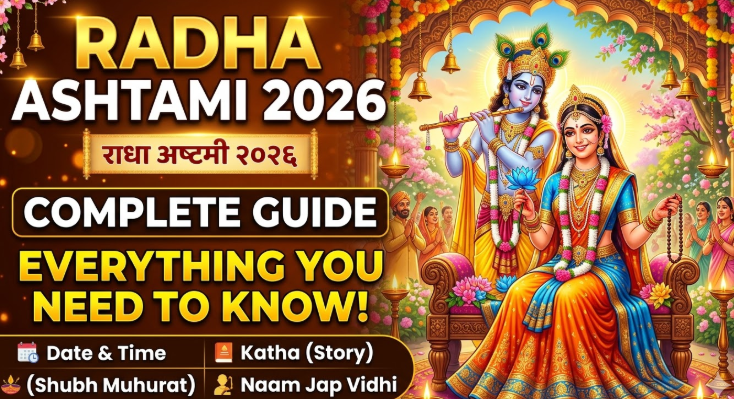
Radha Ashtami 2026 falls on Tuesday, 25th August 2026. The Ashtami tithi (eighth lunar day) of the Shukla Paksha (bright fortnight) of the month of Bhadrapada — this is the sacred day of Radha Rani’s appearance.
The Ashtami tithi will begin on the evening of Monday 24th August 2026 and will be in effect through Tuesday 25th August 2026. The main observance — including puja, fast, and intensive naam jap — is done on Tuesday 25th August.
Brahma Muhurta on this day begins at approximately 4:12 AM. This is the ideal time to begin your naam jap sankalp if you are doing an intensive practice.
The Story of Radha and the Bees — What It Really Teaches About Devotion
Why Radha Ashtami Comes 15 Days After Janmashtami
This is a detail most people do not notice, but once you see it you cannot un-see it.
Krishna appears on Ashtami of Krishna Paksha (dark fortnight) of Bhadrapada. Radha appears on Ashtami of Shukla Paksha (bright fortnight) of the same month. Exactly fifteen days apart. Same tithi. Same month. One in the dark half, one in the light half of the lunar cycle.
The Braj tradition holds that this is not coincidence. It reflects the nature of their relationship — Krishna is the dark, the mysterious, the night-blue depth. Radha is the light, the brightness, the radiance that makes the dark beautiful and meaningful.
Together they complete the month. Together they complete the cycle. The calendar itself holds their relationship.
The Story of Radha Rani’s Appearance
The account of Radha’s birth — or more precisely, Her appearance — is found in the Brahma Vaivarta Purana and in the oral traditions of Braj. It is unlike any ordinary birth narrative.
The Garden of Barsana
Vrishabhanu was a chieftain of Braj, a man known for his deep piety and generous heart. His wife Kirtida was equally devoted — gentle, wise, and quietly radiant in the way of people who have spent years in sincere prayer.
For years they had prayed for a child. Not with demands or bargaining, but with the simple, patient longing of people who trust that what is meant to come will come.
One morning, Vrishabhanu went to bathe in the Yamuna at sunrise. As he entered the golden light on the water, he saw a lotus — extraordinary in its size and brightness — floating toward him on the current. As it reached him, he looked inside it.
A newborn girl lay in the heart of the lotus, eyes closed, completely still, wrapped in golden light.
He carried her home with trembling hands.
The Child Who Did Not Open Her Eyes
Here is the part of the story that most people do not know.
When Radha was born, She did not open Her eyes. Not for days. Not for weeks.
The family rejoiced in Her arrival — She was clearly no ordinary child, the circumstances of Her appearance alone made that certain — but She would not open Her eyes. Healers were called. Prayers were offered. Nothing changed.
Then the news of Vrishabhanu’s miraculous daughter reached the household of Nanda Maharaj — Krishna’s father. A visit was arranged. And Nanda came with his wife Yashoda and their infant son Krishna.
When Krishna — barely a toddler, carried in Yashoda’s arms — was brought near Radha, He leaned forward from His mother’s arms and looked at the still, closed-eyed child.
Radha opened Her eyes.
The first thing She ever saw in this world was Krishna’s face.
“She had been waiting,” the old pujari in Barsana told me when I heard this story there. “She knew what was worth opening Her eyes for. And she was not wrong.”
Vrishabhanu’s household erupted in celebration. And since that day, the tradition in Braj holds: the moment Radha Rani opens Her eyes each morning is a moment of grace for all who are present in Her memory.
The Spiritual Significance of Radha Ashtami
In the Vaishnava understanding, Radha Ashtami is not simply a birthday celebration. It is something more specific and more profound.
Krishna’s appearance day — Janmashtami — is celebrated with great intensity, midnight vigils, and the deep emotion of awaiting the divine. It is charged with anticipation and mystery.
Radha Ashtami has a different quality. It is sweeter. More intimate. Less dramatic and more deeply felt.
The saints say: on Janmashtami, the Lord comes into the world. On Radha Ashtami, the world’s capacity to receive the Lord comes into being. Without Radha, there is no one who can fully receive Krishna’s grace. Her appearance is what makes our devotion possible.
This is why devotees who have a serious naam jap practice often say that Radha Ashtami — not Janmashtami — is the day they feel most connected. Because the day belongs entirely to Her, and She is the one who makes the connection happen.
Fasting Rules for Radha Ashtami
The fast of Radha Ashtami is observed with the following traditional guidelines. These can be adapted based on your health and circumstances — the spirit of the fast is more important than rigid external observance.
Who Should Fast
The fast is traditionally observed by women devotees, though men who have devotion to Radha Rani also keep it. There is no gender restriction in bhakti. If your heart calls you to fast, fast.
The Night Before — Ekadashi Preparation
On the evening of Monday 24th August, eat a light, sattvic meal before sunset. Avoid non-vegetarian food, onion, garlic, and heavy grains from the day before. This prepares the body for the fast and aligns it with the spiritual energy of the approaching tithi.
The Fast Itself — Three Ways to Observe
Full Nirjala Fast: No food or water from sunrise to the evening puja. This is the strictest form, traditionally observed by very dedicated devotees and those in good health. Not recommended for people with medical conditions, pregnant women, elderly, or children.
Phalahar Fast: Fruits, milk, dry fruits, and specific fast-friendly foods like sabudana (tapioca), singhara flour, and rock salt are permitted throughout the day. This is the most commonly observed form and is completely valid as a sincere observance.
Sankalp Fast: Even if you cannot fast from food, you can observe a sankalp — a vow of intention. On this day, vow to do extra naam jap, to avoid any harsh or unkind speech, to spend time in reading about Radha Rani, and to offer flowers and a small diya at Her image. The sankalp fast is complete in itself.
Breaking the Fast
The fast is broken after the evening puja, after offering bhog (food offering) to Radha Rani and receiving prasad. Traditional foods for breaking the fast include panchamrit (milk, curd, honey, ghee, and sugar), fruits, and light sattvic preparations.
How to Do Naam Jap on Radha Ashtami — Hour by Hour Guide
This is the section that will make the most difference if you follow it. Even one Radha Ashtami done with full intention and structure can shift your relationship with naam jap permanently.
4:00 AM — 6:00 AM : Brahma Muhurta Session
Wake before sunrise. Bathe or at minimum wash hands, feet, and face. Light a diya and place it before an image of Radha Rani — even a simple printed photo is sufficient.
Sit in your jap posture and begin. This is your anchor session for the day. Do a minimum of 1008 repetitions of Radhe Radhe in this session. If you can do more, let the session run as long as it wants to.
The quality of jap in brahma muhurta on Radha Ashtami is reported by practitioners across generations as unusually deep. The combination of the sacred tithi and the early morning stillness creates conditions that are genuinely different. Come to this session without rush.
8:00 AM — 9:00 AM : Morning Puja and Story Reading
Offer fresh flowers to Radha Rani’s image. If you have tulsi leaves, offer those. Light incense. Sing or listen to a Radha Rani bhajan — even one song, fully heard, is enough.
Read or listen to the story of Radha Rani’s appearance. Tell it to your children if you have them. The story carries its own grace — it does not need commentary or explanation.
Throughout the Day — Continuous Light Jap
On Radha Ashtami, try to keep the name present throughout the day, not just in your formal sitting sessions. While cooking, while walking, while doing household work — a quiet, continuous Radhe Radhe under the breath.
This is called ajapa jap — unchanted chanting, the name that runs without effort. Radha Ashtami is one of the best days of the year to plant that seed.
Sunset — Evening Aarti Session
At sunset, light a diya again. Offer paan and mishri to Radha Rani’s image — this mirrors the offering made at Nidhivan each evening and connects your home puja to the living tradition of Vrindavan.
Do another sitting of naam jap. This evening session should ideally be 108 repetitions minimum, done slowly and with full feeling. Not counted — felt.
Night — The Sankalp for the Coming Year
Before sleep on Radha Ashtami night, sit quietly for five minutes and make a simple inner sankalp for the year ahead in your bhakti practice. It does not need to be grand. It can be as simple as: I will say Your name every morning before I look at my phone. I will offer a diya every Friday. I will read one thing about Your story every week.
Small sankalpas kept are worth more than grand ones abandoned.
What to Chant on Radha Ashtami
Any sincere repetition of Radha Rani’s name is valid and received. But if you want specific mantras traditionally associated with Her appearance day:
Primary Mantra: Radhe Radhe (simplest, most direct, most beloved in Braj tradition) Ashtami Mantra: Shri Radha Ashtami ki Jai — Vrishabhanu Nandini Radhe Jai For deeper practice: Hare Radhe Hare Radhe, Radhe Radhe Hare Hare
Do not worry about pronouncing Sanskrit perfectly. Radha Rani understands sincerity better than correctness. The name spoken from the heart reaches further than perfect recitation from the head.
If You Cannot Be in Vrindavan — How to Bring Vrindavan Home
Not everyone can travel to Vrindavan for Radha Ashtami. The festival in Vrindavan and Barsana is extraordinary — I encourage you to go at least once in your life — but your home practice on this day carries full value.
A few simple things make a real difference:
Place fresh flowers — any flowers, whatever is available where you live — before Radha Rani’s image. Flowers matter. They are Her offering.
Cook or buy something sweet and offer it before eating. Even a single piece of mishri (rock sugar) offered with intention counts as bhog.
Play Vrindavan kirtan softly in your home through the day — there is beautiful devotional music from Vrindavan easily available to stream. Let the house hold that sound.
Tell someone about Radha Rani today. Share this post. Tell your mother, your sister, your friend, the story of the lotus and the girl who waited to open her eyes. The sharing of Her story is itself a form of seva.
A Final Word — What Radha Ashtami Is Really About
There is a verse in the Braj tradition that goes: on the day Radha appeared, the world received the capacity for perfect love.
Not a particular kind of love. Not romantic love or parental love or devotional love — all of those are just faces of the same one thing. The capacity for love that is complete. Love that does not negotiate or calculate or protect itself. Love that is simply what it is, all the way through, with nothing held back.
We are not capable of that love yet. Most of us. Most days.
But on Radha Ashtami, something in the energy of the day makes it slightly more accessible. The door is a little more open. The name goes a little deeper. The stillness is a little more available.
Use the day. Not to perform devotion but to actually feel it — even for a few minutes, even in a small corner of your busy life.
Radha Rani does not need grand gestures. She opened Her eyes for a single face. She will open the door for a single sincere call of Her name.
Call Her today.
Radhe Radhe 🙏 — Radha Ashtami ki Jai

I’m Ankita, and I love everything about Radha Krishna bhakti. Naam Jap is a daily part of my life, and Radhajap.in is my way of sharing that love and devotion with others.