
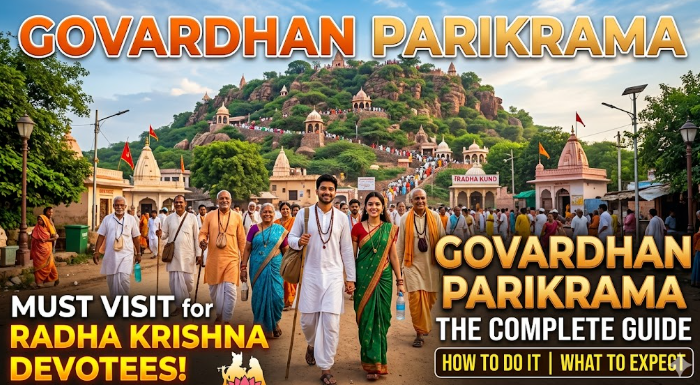
I did my first Govardhan Parikrama on a cold January morning, starting before sunrise with a small group of devotees from our neighbourhood in Nagpur who had made the trip together.
I want to tell you honestly: I was not fully prepared for what it would be. Not physically. Not emotionally. Not spiritually.
By the time I completed the walk and returned to the starting point, I had blisters on both feet, dust on every part of my clothing, and a feeling in my chest that I have not been able to describe adequately to anyone who has not done it themselves. The closest I can come is this: it felt like something had been cleaned inside me that I did not know was dirty.
Here is everything I wish someone had told me before I went.
What is Govardhan Parikrama
Govardhan is a hill — more precisely, a long, low ridge of rock — located in the Braj region of Uttar Pradesh, approximately 22 kilometres from Mathura and about 26 kilometres from Vrindavan. The hill stretches roughly 8 kilometres in length and rises to a modest height, but its spiritual significance is immense.
According to the Bhagavata Purana, it was Govardhan Hill that Lord Krishna lifted on the little finger of his left hand for seven continuous days and nights to protect the people of Braj from the devastating rains sent by Indra. This act — and the story surrounding it — is central to the Braj tradition. Govardhan Hill is considered a direct form of Krishna himself. To touch it, walk around it, prostrate before it, is to have direct darshan of the Lord.
The Parikrama — the circumambulatory walk around the entire hill — is approximately 21 kilometres in length. Most devotees complete it in 5 to 7 hours of walking, with stops at the main shrines along the route.
The Route — Key Stops Along the Way
The Parikrama traditionally starts and ends at Jatipura, near the Mukut Mukharvind Temple, one of the most important shrines on the route, believed to mark the place where Krishna placed his face against the hill and where you can see the natural rock formation that devotees understand as the face of Govardhan.
Proceeding clockwise, the main stops are:
Dan Ghati — The place where the tradition says Krishna would wait for the gopis carrying milk and butter and playfully demand a “tax” from them before letting them pass. There is a temple here and it is one of the most joyful spots on the route.
Mansi Ganga — A sacred lake midway along the route where devotees take a ritual bath or at minimum touch the water. The story holds that this lake arose from Krishna’s mind at the request of the Braj villagers who could not travel to the Ganga easily.
Radha Kund and Shyam Kund — These twin lakes near the eastern end of the parikrama are considered among the holiest spots in the entire Vaishnava world. Radha Kund in particular is held with deep reverence — the water here is said to be charged with the bhakti of Radha Rani herself. Many devotees take a brief dip. If you visit only one place on the entire Braj circuit, Radha Kund is it.
Kusuma Sarovara — A beautifully maintained stepped lake with magnificent octagonal towers. This is one of the most photogenic locations on the route and also a genuine place of meditation and peace.
Govinda Kund and Punchari ka Lautha — Sacred spots in the latter half of the route, associated with stories of Krishna’s leelas.
What to Carry and How to Prepare
Footwear: The majority of devoted pilgrims do the Parikrama barefoot. If this is your first time or you have health considerations, comfortable walking sandals are acceptable. The path is a mix of paved roads, stone paths, and open earthen track. The surface can be rough.
Water: Carry at least 2 litres. There are shops and stalls along the route, particularly at the main shrines, but the sections between them can be long.
Time to start: Before sunrise is ideal. The early morning light, the cooler temperature, and the quietness of the route before tourist crowds arrive make the experience significantly more meaningful. Starting at 4:30 to 5:00 AM is common.
Clothing: Light cotton, loose and modest. Women should have their head covered for the main shrine stops. Carry a small bag with your essentials.
What to leave behind: Your phone, as much as possible. Or at minimum, your habit of photographing everything. The Parikrama is a meditation. Walking it with your camera raised breaks the inner work the walk is meant to do.
The Spiritual Significance for Radha Krishna Devotees Specifically
For devotees who chant Radha naam, the Govardhan Parikrama has a specific emotional quality that pilgrims to Tirupati or Kashi will understand as familiar but also as distinctly Braj.
The Braj landscape — its flat fields, its small ponds, its low light — is the setting of almost every major leela of Radha and Krishna. Walking through it is not abstract. The stories you have heard since childhood, the names you chant daily, the images you sit before in your puja — they all have a geography here. The “Radhe Radhe” that you chant while walking in this landscape feels different in a way that is difficult to articulate.
Many devotees choose to chant continuously throughout the parikrama — either silently, or softly aloud. Some do the parikrama in complete silence. Both approaches are honoured.
Practical Information for Your Trip
Govardhan is best reached from Mathura, which is well connected by train from most major Indian cities. From Mathura, auto-rickshaws and taxis to Govardhan are available at the station. The drive is approximately 30 to 40 minutes.
The best season for Parikrama is October through February, when the heat is manageable. Avoid the summer months (April to June) when afternoon temperatures can make the walk dangerous.
Kartik month (October-November) is considered the most auspicious time, and the Parikrama path is crowded with lakhs of devotees during this period. If you prefer a quieter experience, January and February weekday mornings offer the best balance of sacred atmosphere and manageable crowds.
There is no fee to do the Parikrama. Accommodation is available in Govardhan town in ashrams and simple guesthouses, many of which cater specifically to pilgrims.
One Last Thing
The Govardhan Parikrama will give you exactly as much as you bring to it in terms of intention. If you walk it as a tourist, it is a pleasant 21-kilometre walk through an interesting landscape. If you walk it as a devotee — with your naam jap in your heart, with awareness of what the hill is and what it has witnessed — it becomes something that changes you.
I have done it four times now. Each time, something different opens.
Radhe Radhe.
Radha Krishna bhakti has always been the center of my life, and that’s why I founded Radhajap.in. I’m Vikas, and I believe in the divine power of Naam Jap to transform hearts and bring us closer to Radha Krishna. Through Radhajap.in, I aim to inspire every devotee to embrace a life filled with love, devotion, and the bliss of chanting.