
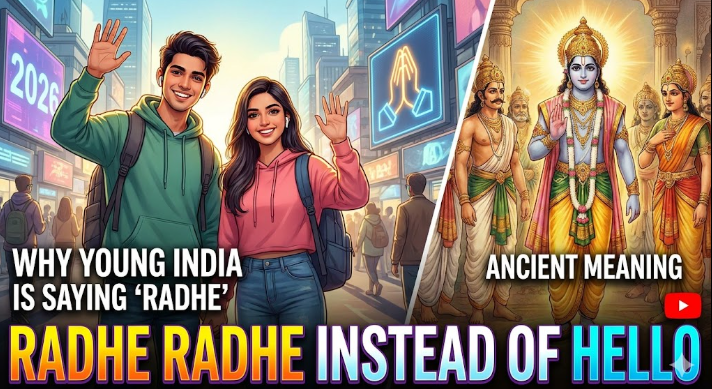
Something has shifted in India, and it is visible on Instagram reels, in WhatsApp group chats, at college campuses, and in the way young people greet each other at satsangs, temples, and even at the chai stall outside the office.
“Radhe Radhe” has replaced hello.
Not among elderly devotees in Vrindavan — they have been saying it for centuries. But among 18-to-30-year-olds in cities across India who may not have grown up in deeply religious households, who may have spent their teenage years scrolling through reels of everything except spirituality, and who now find themselves reaching for a greeting that carries something hello cannot carry.
This is worth taking seriously. It is not a trend in the empty sense — not like a viral dance or a food challenge that will be forgotten in three months. The data from Instagram hashtags, from YouTube search trends, and from the explosive growth of accounts like those of Premanand Ji Maharaj and Jaya Kishori Ji all point to something more structural: a generation that was raised without deep spiritual roots is choosing, on its own, to grow some.
And the greeting they have chosen — “Radhe Radhe” — is not random. It carries several hundred years of devotional history, a precise theological meaning, and a practical spiritual function that most of the people using it may not yet fully know.
Let me tell you what it actually means.
Where the Greeting Comes From — Braj, Not Instagram
The practice of greeting with “Radhe Radhe” originates in the Braj region — the area of Uttar Pradesh that encompasses Vrindavan, Mathura, Barsana, and Govardhan. In this region, the greeting has been used for centuries among Vaishnava devotees, replacing namaste, pranam, or any other standard Indian greeting.
It is used upon meeting someone, upon leaving, as an acknowledgement, as a response to thanks, as a way of ending a conversation. In Vrindavan, if you say Radhe Radhe to a complete stranger — a shopkeeper, a rickshaw driver, an elderly woman carrying flowers to the temple — they will respond with Radhe Radhe without any pause or self-consciousness. The name is the language of the place.
The practice spread beyond Braj through the bhakti movement saints — particularly through the Gaudiya Vaishnava tradition established by Chaitanya Mahaprabhu in the 16th century, and through the teachings of saints like Premanand Ji Maharaj whose reach has now extended through digital platforms to the entire country.
What is happening in 2026 is not something new being invented. It is something very old becoming visible again in a new generation.
Free Online Radha Naam Jap Counter – Chant with Devotion, Count with Ease
The Exact Meaning of Radhe Radhe — More Than a Greeting
The word Radhe is the vocative form of Radha — it means, literally, O Radha. When you say Radhe Radhe, you are not making a declarative statement. You are calling. You are invoking. You are saying the name of Radha Rani twice — which in the Braj tradition is the most natural and complete form of calling her.
The repetition is not accidental. In Sanskrit poetics and in devotional practice, the doubling of a name indicates intensification — deeper calling, more earnest address. Radhe Radhe is not Radha said twice for rhythm. It is the sound of a heart calling to its beloved with both breath and soul.
When two devotees greet each other with Radhe Radhe, they are not simply exchanging pleasantries. They are, at the level of the sound itself, invoking Radha Rani’s presence between them. They are reminding each other, in two words, of what the day is ultimately about and who it is ultimately for.
This is why the greeting has the quality it has — even among people who do not know this theology consciously. When someone says Radhe Radhe to you and means it, even a little, something in the exchange feels different from hello. Hello is contact. Radhe Radhe is recognition.
The Naam Itself — Why the Sound Matters
The bhakti tradition has always understood sound as sacred in a way that goes beyond meaning. The name of Radha Rani is not simply a word that refers to a divine being — it is, in this tradition, an actual form of that being. The name and the named are not separate.
The Narada Bhakti Sutras, the Bhagavata Purana, and the Gaudiya acharyas all speak of this: that the name of the divine is the most direct and accessible form of the divine available to human beings. You do not need a temple, a murti, a priest, an initiated practice, or a Sanskrit education to access the grace of Radha Rani. You need only the name.
When you say Radhe Radhe as a greeting, you are doing naam jap — however briefly, however casually. Every time the name passes through your lips and your breath, something registers. The tradition says that no utterance of the name is wasted, not even an accidental one. The name does its work regardless of the level of intention with which it is spoken.
This is why generations of Braj devotees have used it as a greeting: because they wanted the name on their lips as often as possible, and greeting others was the perfect opportunity. Every hello is a missed chance. Every Radhe Radhe is not.
What the Gen Z Bhakti Wave Actually Means
It would be easy to be cynical about the current wave of young people adopting spiritual practices — to call it aesthetic spirituality, identity performance, a reaction to digital burnout that will pass when the next trend arrives.
I do not think that reading is accurate, and here is why.
The young people who are saying Radhe Radhe, who are following Premanand Ji Maharaj, who are posting their morning naam jap counts, who are visiting Vrindavan in numbers that are visibly growing — many of them have not been raised in practicing religious households. Their parents may be nominally Hindu but not devotionally active. The children have found this on their own, through reels and YouTube, through the experience of sitting in front of a screen and feeling something when a saint spoke.
That is not aesthetic consumption. That is the beginning of a genuine search.
The bhakti tradition has always been democratising in this way — it does not require social standing, education, caste, or family background. It requires only a heart that is genuinely calling. And the hearts of this generation, however formed by algorithms and anxiety and distraction, are genuinely calling.
Radhe Radhe is one of the ways they are beginning to answer that call. Two words. Centuries old. Available to anyone. No qualification required.
How to Use Radhe Radhe in Your Own Daily Practice
If you are not yet in the habit of greeting with Radhe Radhe, consider starting small and genuine. Do not adopt the greeting as performance or trend. Begin with one context where it feels natural — among fellow devotees at a satsang, or in your morning puja space when you light the lamp.
From there, let it expand naturally. The name has its own momentum. Once it begins to feel natural in one context, it spreads to others.
And when you sit for your daily naam jap — whether on a Tulsi mala or using the free counter at RadhaJap.in — remember that you are doing a version of the same thing as every young person saying Radhe Radhe on Instagram this week. You are calling. She is listening. The only variable is how long you choose to keep calling.
Radhe Radhe.
Radha Krishna bhakti has always been the center of my life, and that’s why I founded Radhajap.in. I’m Vikas, and I believe in the divine power of Naam Jap to transform hearts and bring us closer to Radha Krishna. Through Radhajap.in, I aim to inspire every devotee to embrace a life filled with love, devotion, and the bliss of chanting.