
We live in an age of fragmented attention. With notifications pinging every few seconds, short-form videos destroying our attention spans, and a constant influx of digital noise, our brains are in a state of perpetual hyper-arousal.
For a spiritual seeker trying to practice Radha Naam Jap, this distraction is a massive barrier. Many devotees complain: “I sit to chant, but my mind wanders within five minutes. I feel no connection, no depth, and no transformation.”
The secret to breaking through this mental static does not lie in chanting for hours with a scattered mind. It lies in understanding the profound relationship between time, human physiology, and spiritual sound vibrations.
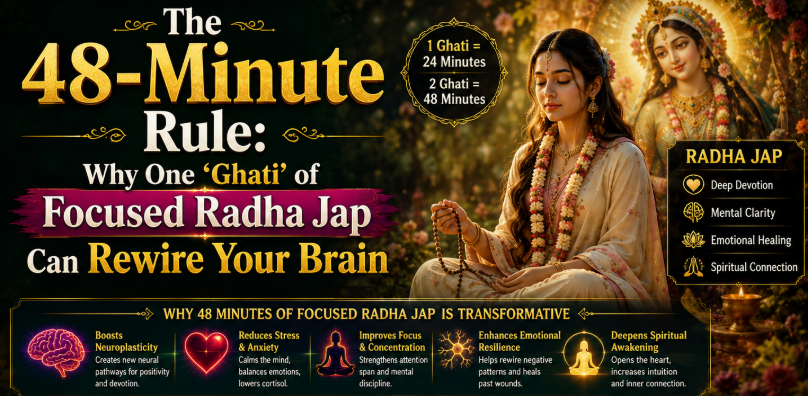
In ancient India, the sages calculated time not in arbitrary hours and minutes, but in natural, biological cycles. At the heart of this calculation lies a powerful unit of time: The Ghati and the Muhurta (48 minutes).
Dedicating exactly 48 minutes of highly focused, uninterrupted Radha Naam Jap daily is a neurological quantum leap. Let’s explore the deep spiritual science and modern neuroscience behind The 48-Minute Rule and how it can completely rewire your brain.
Decoding Vedic Time: What is a Ghati and a Muhurta?
Thus, one Ghati equals exactly 24 minutes.
Vedic Day/Night Cycle (24 Hours)
   ├── Divided into 60 Ghatis (1 Ghati = 24 Minutes)
   └── Divided into 30 Muhurtas (1 Muhurta = 2 Ghatis = 48 Minutes)
This 48-minute period is not an arbitrary number. It is a fundamental cosmic rhythm that directly corresponds to our human physiology, specifically our nasal cycle and brain hemisphere dominance. Every 48 to 90 minutes, our dominant nostril shifts, changing our internal states from logical analysis (Pingala/Left brain) to creative intuition (Ida/Right brain).
By chanting Radha Naam for an entire 48-minute period (one Muhurta), you bridge this physiological transition, forcing your life energy (Prana) into the central channel, the Sushumna Nadi, inducing deep, spontaneous meditative states.
The Neuroscience of focused Chanting: What Happens in the Brain?
When you sit for 48 minutes of focused Radha Naam Jap, you are not just performing a religious ritual; you are performing non-invasive, self-directed neurosurgery. Here is how focused spiritual chanting rewires the physical structures of your brain:
[ Default Mode Network (DMN) ] ──(Silenced by Focused Jap)──► Calm, Ego-Free State
[ Amygdala (Fear Center) ]      ──(Shrunk by Cortisol Drop)──► Reduced Anxiety
[ Prefrontal Cortex ]           ──(Activated by Attention) ──► Enhanced Focus & Will
1. Silencing the Default Mode Network (DMN)
The DMN is a network of interacting brain regions active when a person is not focused on the outside world. It is responsible for the “mind-wandering,” self-referential thought patterns, rumination, regret about the past, and anxiety about the future.
A hyperactive DMN is linked to clinical depression and anxiety. Neuroimaging studies show that rhythmic, repetitive chanting of sacred mantras immediately quiets the DMN, plunging the brain into a state of profound, present-moment spaciousness.
Nidra Samadhi: How to Turn 6 Hours of Sleep into Continuous Radha Naam Jap
2. Shrinking the Amygdala (The Fear Center)
The amygdala is the brain’s alarm system, constantly scanning the environment for threats. In our modern, high-stress lifestyle, our amygdala is chronically overactive, leading to constant low-grade anxiety, anger, and stress.
Focused mantra meditation over a sustained period of 40-48 minutes drops cortisol (the stress hormone) levels dramatically. Over time, this daily practice physically shrinks the amygdala, reducing your susceptibility to fear, anger, and panic.
3. Strengthening the Prefrontal Cortex (The Seat of Consciousness)
The prefrontal cortex controls your attention, willpower, emotional regulation, and decision-making. By consciously pulling your wandering mind back to the sound of “Radha” over a 48-minute period, you are lifting mental weights. This strengthens the gray matter density in your prefrontal cortex, enhancing your concentration, memory, and cognitive resilience.
Why Radha Naam is a Trans-Cerebral Catalyst
Not all sound vibrations are created equal. The name “Radha” (राधा) is a transcendental powerhouse of phonetic science. It is composed of two highly potent seed vibrations:
- “Ra” (रा): This sound is an upward-moving, energizing, solar vibration. In Sanskrit etymology, “Ra” has the power to burn away all impurities, past karmas, and mental blocks. It ignites the fire of divine love (Prem-Agni) inside the heart.
- “Dha” (धा): This sound is a stabilizing, grounding, nourishing, lunar vibration. “Dha” means to hold, sustain, and embrace. It instantly calms the nervous system, bringing a deep, soothing peace and establishing the soul in its eternal spiritual home.
When these two syllables are chanted rhythmically and continuously, they create an alternate hemispheric stimulation in the brain, harmonizing the left and right hemispheres. This brings immediate balance to your nervous system, allowing you to easily access states of deep meditation.
The 48-Minute Radha Jap Sadhan: A Step-by-Step Practical Protocol
To experience the profound brain-rewiring benefits of this rule, you must practice it with precision. Follow this systematic, daily protocol:
Step 1: The Sanctuary of Time & Space
Choose a fixed time every day. The most auspicious time is during the Brahma Muhurta (approx. 1.5 hours before sunrise), but any quiet hour of the day will work.
- Find a clean, quiet corner in your home.
- Sit on a natural fiber mat (wool, silk, or cotton) to prevent your body’s bio-electric energy from grounding into the earth.
- Keep your phone in another room or put it on airplane mode. No exceptions.
Step 2: Asana Jaya (Physical Stillness)
Your brain cannot enter deep meditation if your body is constantly moving.
- Sit comfortably with your spine erect, shoulders relaxed, and chest open. You can sit on the floor in Sukhasana (easy pose) or on a straight-backed chair if you have back issues.
- Make a firm commitment to yourself: “For the next 48 minutes, I will not move my physical body unless absolutely necessary.” * Keeping your body completely still (Asana Sthirata) sends a signal to your brain that it is safe to turn off its motor defense systems, allowing your mind to quiet down rapidly.
Step 3: Shravana Sadhana (The Art of Deep Hearing)
The secret to focused chanting is not in how fast you chant, but in how deeply you hear the sound.
- Chant the name “Radha” clearly, either aloud (Vaikhari), in a whisper (Upanshu), or mentally (Manasa).
- Focus your entire attention on the sound of the syllables. Hear the start of the syllable
Ra, the transition, and the end of the syllableDha. - When your mind wanders (and it will), do not get frustrated. Simply recognize the wandering mind and gently, lovingly bring it back to the sound of the name.
[ Mind Wanders ] ──► Recognize Without Judgment ──► Gently Pull Back ──► [ Focus on Sound of "Radha" ]
The 48-Minute Timeline: What Happens inside your brain as you chant?
Let’s break down what happens neurologically and spiritually during this 48-minute session:
[ Min 0 - 12 ] ──► [ Min 12 - 24 ] ──► [ Min 24 - 36 ] ──► [ Min 36 - 48 ]
  Active Resistance   The Chemical Shift   Deep Flow State     Neural Lock-In
Minutes $0$ to $12$: The Phase of Active Resistance (Beta State)
Your brain is still dealing with the momentum of your day. The mind will scream for distraction, reminding you of pending emails, chores, or random thoughts. This is the test of willpower. Keep breathing deeply, maintain physical stillness, and keep chanting.
Minutes $12$ to $24$: The Chemical Shift (Alpha State)
As the rhythmic sound of Radha Naam is repeated, your heart rate slows down and your breathing pattern becomes regular. The brain begins to produce alpha waves. The superficial mental chatter starts to fade, replaced by a warm, soothing sense of relaxation.
Minutes $24$ to $36$: The Deep Flow State (Theta State)
You enter a deep flow state. The boundary of your physical body starts to soften. The chanting begins to feel effortless—it feels as if the name is chanting itself, and you are simply listening. You access the deeper, subconscious layers of your mind, clearing out old stresses and anxieties.
Minutes $36$ to $48$: The Neural Lock-In (The Peak Muhurta)
During these final 12 minutes, the brain enters its most coherent state. The left and right hemispheres are completely synchronized. You experience a deep sense of joy, oneness, and divine presence (Bhav). The brain lays down deep, permanent neural pathways of devotion. When you open your eyes after 48 minutes, you feel like a completely new person.
Long-Term Benefits of the 48-Minute Rule
By practicing this focused sadhana consistently for just 21 days, you will notice profound, visible changes in your daily life:
- Elimination of Brain Fog: Your thinking becomes crystal clear, and your ability to focus on complex professional or academic tasks increases exponentially.
- Emotional Resilience: You are no longer easily shaken by criticism, bad news, or stressful situations. A deep reservoir of inner peace keeps you anchored.
- Overcoming Addictions: The high spiritual satisfaction (Ananda) generated by focused Radha Jap replaces the cheap dopamine hits of social media, junk food, and bad habits.
- Enhanced Intuition: As your mind becomes silent, the voice of your soul and divine guidance becomes clear and loud, helping you make right decisions effortlessly.
- Awakening of Bhakti: You begin to feel a genuine, sweet love and longing for the Divine Couple, transforming your spiritual life from a dry duty into an ecstatic love affair.
Practical Tips for Beginners
If 48 minutes feels daunting at first, do not worry. You can build up to it gradually:
- The $24 + 24$ Method: Start with 24 minutes (one Ghati) of focused chanting in the morning and 24 minutes in the evening. Once you are comfortable, merge them into a single 48-minute morning session.
- Use a Timer: Set a peaceful, soft-sounding alarm for 48 minutes so you don’t have to constantly open your eyes to check the clock.
- Keep a Japa Tracker: Use a journal to mark a simple tick next to each day you successfully complete your 48-minute sadhana. Tracking your progress builds psychological momentum.
Conclusion: Rewire Your Destiny
Your brain is a plastic organ, constantly being shaped by your thoughts and actions. If you feed it chaos, worry, and digital junk, your life will reflect that confusion. But if you give your brain the supreme gift of one Muhurta—48 minutes—of focused Radha Naam Jap every day, you will completely transform your physical, mental, and spiritual destiny.
Sit still. Close your eyes. Set your timer. And let the sacred name of Radha Rani rewrite the biology of your brain.
Frequently Asked Questions (FAQs)
1. Can I break the 48 minutes into two 24-minute sessions?
While two 24-minute sessions are highly beneficial and a great starting point for beginners, the true neurological and physiological “rewiring” benefits of the rule occur when you sit continuously for 48 minutes. This is because it takes the brain about 15-20 minutes just to quiet the superficial thoughts and enter the deep, restorative Theta-wave state.
2. Is it better to chant Radha Naam silently in the mind or aloud?
For the 48-minute focused rule, chanting in a soft whisper (Upanshu) or clearly aloud (Vaikhari) is highly recommended for beginners. Chanting aloud engages your vocal cords, tongue, and ears, making it much easier to pull your mind back from distractions. As your concentration deepens, you can naturally transition to silent mental chanting (Manasa Jap).
3. What should I do if my legs fall asleep or pain starts during the 48 minutes?
If you experience minor discomfort, try to observe it with detachment and maintain physical stillness; it often passes. However, if you experience sharp pain or your legs fall completely asleep, gently and slowly change your posture without breaking the internal chanting. You can also sit on a chair or lean against a wall to ease physical strain.
4. Why is this rule specifically called the “48-Minute Rule” instead of one hour?
This rule is rooted in the precision of Vedic timekeeping. An hour (60 minutes) is a modern, artificial division of time. A Muhurta (48 minutes/two Ghatis) is a natural, organic biological unit of time that aligns with the human body’s circadian rhythms and nasal cycles, making spiritual absorption far more accessible.
5. Can I listen to background music or instrumental sitar while doing this Jap?
For this specific focused practice, it is best to chant in complete silence. Background music, even if spiritual, acts as an external sensory input that keeps your conscious mind active. The goal of the 48-minute rule is to immerse yourself completely in the raw, unadulterated, transcendental sound vibration of your own chanting of Radha Naam.

I’m Ankita, and I love everything about Radha Krishna bhakti. Naam Jap is a daily part of my life, and Radhajap.in is my way of sharing that love and devotion with others.