
Let me be honest with you from the start.
Four years ago my mornings were a mess. I would wake up late, scroll my phone for 20 minutes while still lying in bed, rush to drink tea, and then try to sit for naam jap with a mind that was already scattered in fifteen directions.
The jap happened. But it did not go deep. It felt like chanting with one hand while the other hand was still busy with everything else.
Then someone — an older devotee I met at a satsang in Vrindavan — asked me a simple question: “What does your body feel like when you sit down to chant?”
I had never thought about it. I said: tired, a bit heavy, not fully awake.
She said: “Then your body is not ready to receive what the name can give. Ayurveda cleans the vessel before you fill it.”
That one sentence changed my mornings completely.
Over the next year I slowly built an Ayurvedic morning routine — not all at once, not perfectly, but step by step. And what happened to my naam jap as a result was significant. The quality of presence I could bring to the name improved. The sitting felt different. The name went deeper.
This post is my actual routine. Exactly what I do every morning before I sit for naam jap. I have explained each step in simple language — what it is, why Ayurveda recommends it, and what difference it has made for me personally.
You do not need to do all of it. Start with one step. Add another when the first one feels natural. That is exactly how I built this routine — and it is the only way any routine actually sticks.
What Is Dinacharya? (In Simple Words)
Dinacharya is an Ayurvedic word. Dina means day. Acharya means routine or discipline. Together it simply means — your daily routine, designed to keep the body and mind clean, healthy, and balanced.
Ayurveda teaches that your body is not the same throughout the day. Different energies — called doshas — are active at different times. The early morning hours are the lightest and most sattvic. The mind is freshest. The body is ready to let go of the toxins built up overnight.
The whole point of Dinacharya is simple: clean the body and clear the mind BEFORE you fill them with the day. For a spiritual person, this is even more important — because you are not just preparing for a productive workday. You are preparing a vessel for the divine name.
Here is what Ayurveda says about the early morning window: between approximately 4:00 AM and 6:00 AM is called Brahma Muhurta — the hour of Brahma. It is the most peaceful, most sattvic, most spiritually potent time of the day. The atmosphere is clean. The mind is quiet. The name goes deeper in this window than at any other time.
The entire Ayurvedic morning routine is designed to make you ready — physically and mentally — to use this window fully.
My Complete Ayurvedic Morning Routine — Step by Step
Here is exactly what I do every morning, in order, with the approximate time each step takes.
Step 1 — Wake Up Early (4:00 AM to 5:30 AM)
I wake up between 4:00 and 5:30 AM depending on the season. In winter I aim for 4:30 AM. In summer — when sunrise is earlier — 4:00 AM is easier because the body naturally wants to rise with the light.
When I wake, the first thing I do is NOT pick up my phone.
I know that sounds simple. It is not easy. But it is the single most important change I made to my mornings. The phone can wait. Every notification, every message, every piece of news that you consume in the first minutes of the day immediately fills the mind with noise. That noise takes 30 to 60 minutes to settle again. And those 30 to 60 minutes are your Brahma Muhurta — gone.
Instead, I lie still for two to three minutes. I remember Radha Rani. I say Her name once — quietly, just to myself — before I get out of bed. That one repetition before anything else sets the intention for the entire morning.
What Ayurveda says: According to Dinacharya, waking during Brahma Muhurta — approximately 90 minutes before sunrise — aligns the body with its natural Vata energy, which supports mental clarity and spiritual practice. Modern science agrees: cortisol naturally peaks in the early morning, supporting alertness and focus. Early rising works with your body’s natural hormonal rhythm, not against it.
Step 2 — Drink Warm Water (2 Minutes)
The first thing that goes into my body every morning is warm water. Not tea. Not coffee. Not cold water from the fridge. Plain warm water — approximately one to two glasses, drunk slowly.
I have been doing this for four years and I genuinely cannot overstate the difference it makes. Within 10 to 15 minutes of drinking warm water, the digestive system wakes up and the body naturally wants to eliminate. This is exactly what Ayurveda is aiming for — clearing the previous day’s accumulation before you begin the new day.
Some mornings I add a small piece of fresh ginger or half a lemon to the water. Not always — plain warm water is perfectly sufficient and in fact preferred in Ayurveda.
What Ayurveda says: Drinking warm water first thing in the morning stimulates the digestive fire (Agni), supports natural bowel elimination, and begins the detoxification process the body was working on overnight. A clean digestive system directly supports a clearer mind — and a clearer mind does better jap.
Do NOT drink cold water first thing in the morning. Cold water dampens the digestive fire that Ayurveda works to maintain. This is one of the most common morning habits that directly works against both your physical health and the quality of your meditation and jap.
Step 3 — Tongue Scraping (1 Minute)
This is the step that surprises people most when I mention it. And it is the step that, once you start doing it, you cannot imagine skipping.
Tongue scraping means exactly what it sounds like — using a U-shaped metal scraper (copper or stainless steel) to gently scrape from the back of the tongue to the front, 7 to 14 times.
The coating you see on your tongue each morning is not normal. Ayurveda calls it Ama — undigested toxins that the body has been processing and moving toward elimination overnight. Scraping it off before it gets reabsorbed into the body is one of the simplest and most effective detoxification practices that exists.
I use a copper tongue scraper. Copper has natural antibacterial properties and is traditionally recommended in Ayurveda. The scraper cost me ₹80 from a local shop and I have been using it for four years.
What Ayurveda says: Tongue scraping removes bacteria, toxins, and dead cells from the tongue’s surface that would otherwise be swallowed and reabsorbed. It also activates the taste buds, stimulates digestive organs, and freshens the breath. After scraping, I rinse my mouth with warm water before brushing.
Step 4 — Oil Pulling (10 to 15 Minutes)
Oil pulling is the practice of swishing oil in your mouth for several minutes — exactly like a mouthwash, but with oil instead of liquid.
I use cold-pressed sesame oil — one tablespoon, held in the mouth and swished gently (not vigorously) for 10 to 15 minutes while I am doing other morning tasks like washing my face or tidying my space.
The oil draws bacteria, toxins, and impurities out of the gums, teeth, and oral tissue. After 10 to 15 minutes it becomes thin and milky — a sign that it has done its work. I spit it out (NOT into the drain — it can clog pipes), rinse thoroughly with warm water, and then brush my teeth normally.
I was skeptical of this practice for the first month. But my dentist noticed a difference in my gum health before I even mentioned it. And the quality of freshness in my mouth after this practice is genuinely different from brushing alone.
What Ayurveda says: Known as Kavala Graha in Sanskrit, oil pulling strengthens gums, removes plaque, reduces harmful bacteria in the mouth, and draws toxins out of the body. Sesame oil is the traditionally preferred oil in Ayurveda for this practice. Coconut oil is also widely used and effective.
Step 5 — Neti Pot or Warm Water Face Wash (3 to 5 Minutes)
After oral hygiene, I clean my face with cold water — splashing it 7 to 10 times while keeping the eyes open. This wakes the eyes and clears the vision. It is simple and takes 30 seconds.
Two or three times a week I also use a neti pot — a small pot filled with warm saline water that you pour through one nostril and let drain through the other. If you have never done this, it sounds strange. It feels strange the first time. But it is one of the most effective practices I know for keeping the sinuses clear, reducing morning grogginess, and improving the quality of breathing in pranayama and naam jap.
Clear nasal passages are important for a naam jap practitioner specifically — because pranayama and deep breathing are done through the nose, and blocked sinuses immediately limit how deep that breath can go.
What Ayurveda says: Neti — nasal cleansing — is one of the Shatkarmas (six classical cleansing practices) of yoga and Ayurveda. Putting 2 to 5 drops of warm sesame oil or ghee into each nostril after neti (this is called Nasya) lubricates the nasal passages, cleans the sinuses, and according to Ayurveda, nourishes the brain and improves mental clarity.
Step 6 — Abhyanga — Self Oil Massage (10 to 15 Minutes)
This is my favourite step. And it is the one that has made the biggest single difference to how I feel when I sit for naam jap.
Abhyanga means self-massage with warm oil. I heat a small amount of sesame oil (about 2 to 3 tablespoons) — either in a small vessel placed in hot water or in a microwave for 15 seconds — and then massage it into my entire body before bathing.
The technique is simple: long strokes on the arms and legs (always toward the heart), circular strokes on the joints (shoulders, elbows, knees, ankles), and gentle circular strokes on the abdomen in the direction of digestion (clockwise). I do this for 10 to 15 minutes and then wait another 5 to 10 minutes for the oil to absorb before bathing.
What does this have to do with naam jap? Everything.
The nervous system that is tight, anxious, and rushing cannot settle into naam jap. The name requires a certain quality of physical ease — not sleepiness, but ease. Abhyanga calms the nervous system at a physiological level. After 10 minutes of warm oil massage, the body is genuinely more settled. The mind follows.
Ayurveda considers Abhyanga one of the most anti-ageing, most calming, and most rejuvenating practices available. Daily self-massage with warm sesame oil nourishes the skin, supports lymphatic circulation, calms Vata dosha (the energy of anxiety and scattered thinking), and according to Ayurvedic texts, promotes longevity. Even 10 minutes produces measurable improvements in nervous system regulation.
Sesame oil is the primary Abhyanga oil for Vata and Kapha body types. Coconut oil is preferred for Pitta types. If you do not know your dosha, sesame oil is a safe and effective choice for most people in the cooler months. In summer, coconut oil is more appropriate.
Step 7 — Bath or Shower (5 to 10 Minutes)
After Abhyanga I bathe. Not a long shower — a thorough but efficient bath that removes the excess oil from the skin and fully awakens the body.
Ayurveda recommends bathing with warm — not hot — water in the cooler months and cooler water in summer. Very hot water strips the skin of the oils you just applied and disrupts the Vata-calming effect of Abhyanga. Warm water preserves the benefit.
After bathing I put on clean, fresh clothes. This sounds obvious — but Ayurveda is specific about it: wearing clean clothes for the morning practice is not just hygiene, it is an act of respect for what you are about to do. You are preparing to sit in front of the divine. The clothes matter.
Step 8 — Pranayama — Breathing Exercises (10 to 15 Minutes)
Now the body is clean. The oil has calmed the nervous system. The bath has made me fully awake. The next step is to prepare the breath — because naam jap rides on the breath.
I sit in my jap posture — on the floor on a folded blanket or a small asana, spine straight but not rigid — and do three rounds of pranayama.
Anulom Vilom (Alternate Nostril Breathing): I close my right nostril with my right thumb, inhale through the left. Then close the left with my ring finger, exhale through the right. Then inhale through the right, close it, exhale through the left. That is one round. I do 12 rounds. This practice balances both sides of the nervous system, calms the mind, and improves the quality of mental focus immediately.
Bhramari (Humming Bee Breath): I close my ears with my thumbs, place fingers gently over my eyes, and make a low humming sound on the exhale — like a bee. The vibration goes directly to the brain. 5 to 7 rounds of this before naam jap produces a quality of inner stillness that I have not found in any other single practice. The transition into naam jap after Bhramari feels completely natural.
Kapalbhati (Skull Shining Breath): Short, sharp exhales through the nose with passive inhales. I do 30 to 50 rounds. This clears any remaining mental fog, stimulates the digestive fire, and energises the entire body without agitating it.
Total time for pranayama: 10 to 15 minutes. The mind that sits for naam jap after this pranayama is genuinely different from the mind that sits without it. More settled. More present. More ready.
Step 9 — Naam Jap (108 to 1008 Repetitions)
Now I am ready.
The body is clean. The nervous system is calm. The breath is regulated. The mind is present. The vessel — as that devotee in Vrindavan said — is prepared.
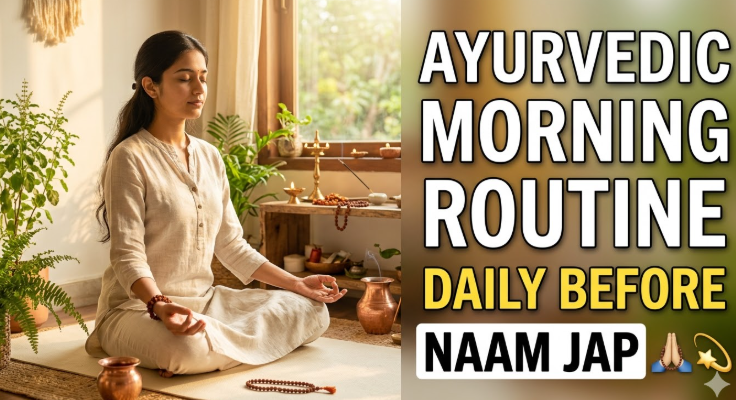
I light a small diya in front of Radha Rani’s image. I light incense. I sit in my jap posture, take up my mala, close my eyes for one breath, and begin.
Radhe Radhe.
On most mornings I do 108 repetitions — one full mala. On days when I have more time or when it is a special day (Ekadashi, Radha Ashtami, Ram Navami), I do more. I use the Radha Naam Jap Counter at RadhaJap.in to track my count on longer sessions.
The difference between this jap — done after the full Ayurvedic morning preparation — and the jap I used to do by rolling out of bed and immediately sitting — is not small. The name settles at a different depth. The mind stays with it more naturally. The sitting does not feel like an effort to concentrate. It feels like coming home.
The Ayurvedic morning routine does not replace naam jap. It prepares you for it. Think of it this way: the name is the seed. The prepared mind and body is the soil. Healthy soil grows things that rocky soil cannot.
Step 10 — Sattvic Breakfast (After 7:00 AM)
After naam jap I eat breakfast. Never before — at least not on most mornings. The body that has been through pranayama and jap is not ready for heavy food immediately. It needs a few minutes to transition.
My breakfast is always sattvic — completely vegetarian, simple, and nourishing. My usual morning food includes warm dal or khichdi with ghee, fresh fruit, or soaked dry fruits (raisins, almonds, dates). Sometimes just fruits and warm milk with a pinch of turmeric.
I avoid: onion, garlic, heavily spiced food, cold food from the fridge, and packaged processed food in the morning. All of these increase Rajas (restlessness) and Tamas (heaviness) — the two qualities that directly work against both digestion and spiritual practice.
Ayurveda’s morning food rule is simple: eat light, eat warm, eat fresh. The digestive fire is gentle in the morning — not yet at its peak, which is midday. Give it food it can handle easily. Your energy levels through the entire day will be steadier as a result.
How to Start — If You Cannot Do All 10 Steps
I know this looks like a lot. When I first read about Ayurvedic morning routines years ago I felt overwhelmed too.
Here is the truth: I did not start with all 10 steps. I started with two.
Week 1: I just woke up 30 minutes earlier and drank warm water before anything else.
Week 2: I added tongue scraping.
Week 3: I added pranayama before jap.
And so on. Each step I added only when the previous one felt completely natural and automatic — not before.
Four years later this entire routine takes me about 60 to 75 minutes total, and it does not feel like effort. It feels like the natural way a morning works. I cannot imagine starting a day any other way.
Start here — The Three Steps That Make the Biggest Difference Fastest: 1. Wake 30 minutes earlier and NO phone for the first 30 minutes 2. Warm water first thing — before anything else enters your body 3. Five minutes of Anulom Vilom pranayama before sitting for naam jap Just these three changes will noticeably improve the quality of your naam jap within two weeks. Add the rest gradually.
Products I Actually Use — Simple and Affordable
People often ask me what products I use for this routine. Here is my honest list — nothing expensive, nothing that requires a special order. All of these are available at any local Ayurvedic store or online.
Copper Tongue Scraper: ₹80 to ₹150 at any local Ayurvedic shop or on Amazon India. Copper is traditionally recommended — it has antibacterial properties and lasts for years. One purchase, permanent addition to your routine.
Cold-Pressed Sesame Oil (for Abhyanga and Oil Pulling): ₹150 to ₹300 for 500ml. Look for pure, cold-pressed, unrefined sesame oil — not the refined cooking variety. Brands like Anveshan, Conscious Food, or locally available cold-pressed oils work well. One 500ml bottle lasts approximately 3 to 4 weeks.
Neti Pot: ₹150 to ₹300 at any yoga supply shop or on Amazon India. Ceramic or stainless steel is better than plastic. Use with food-grade non-iodised salt in warm water — approximately half a teaspoon per 500ml of warm water.
Jap Mala (Tulsi or Rudraksha): ₹200 to ₹800 depending on quality. Tulsi mala is traditionally used for Radha Krishna naam jap. Available at any temple town shop or reliable online spiritual goods retailers. For digital counting alongside your mala, use the free Radha Naam Jap Counter at RadhaJap.in.
I am not an Ayurvedic doctor and I do not recommend specific medical products. If you have any health conditions — heart issues, high blood pressure, kidney problems, pregnancy — please consult a qualified Ayurvedic practitioner before beginning Abhyanga, Kapalbhati, or any intensive pranayama practice. This routine is my personal practice, shared for information. Customise it to your needs.
Frequently Asked Questions
I cannot wake up at 4 AM. Can I still do this routine?
Yes. Brahma Muhurta is the ideal — but it is not the only option. Even waking at 5:30 or 6:00 AM and following this routine before any phone use or outside noise is enormously better than waking at 7:30 AM and immediately diving into the day. Start with whatever wake time is 30 to 45 minutes earlier than your current time. Build from there. Consistency of a modest routine beats occasional perfection of an extreme one every time.
How long does the full routine take?
My full routine takes 60 to 75 minutes: Wake and warm water (5 minutes), tongue scraping and oil pulling (15 minutes), face wash and neti (5 minutes), Abhyanga (15 minutes), bath (10 minutes), pranayama (15 minutes), naam jap (15 to 30 minutes). Total: approximately 80 to 95 minutes including jap. If time is short, skip Abhyanga and the neti pot but keep warm water, tongue scraping, pranayama, and jap.
Which oil is best for Abhyanga?
Sesame oil (cold-pressed, unrefined) is the primary recommendation in Ayurveda for most people, especially in cooler months and for Vata body types. Coconut oil is better for Pitta types and in hot summer months. For Kapha body types, lighter oils like mustard or lighter sesame work well. If you are not sure of your dosha, sesame oil is the safest starting choice for most Indian climates and constitutions.
Can I do oil pulling with coconut oil instead of sesame?
Yes. Coconut oil is widely used for oil pulling and is effective. It has a milder taste than sesame, which many people find easier to manage for 10 to 15 minutes. Sesame oil is the classical Ayurvedic recommendation, but coconut oil produces similar benefits and is perfectly appropriate.
What if I only have 20 minutes before naam jap?
Do this: warm water (2 minutes), tongue scraping (1 minute), Anulom Vilom pranayama (7 minutes), naam jap (10 minutes). That 20-minute routine done consistently is worth more than an elaborate routine done occasionally.
Is this routine different for women?
The core routine is the same. However, Ayurveda recommends modifications during menstruation — avoid Kapalbhati and intense pranayama during the first 3 to 4 days. Gentle Anulom Vilom is fine. Abhyanga with slightly cooler oil is recommended. During pregnancy, please consult an Ayurvedic doctor before beginning or continuing any intensive practice.
Final Thought — Why Preparing the Body Is Not Separate from Bhakti
Some people worry that spending 60 minutes on the body before naam jap means the body is getting more attention than God.
I understand that concern. But I think it is based on a misunderstanding of what the body is.
Your body is the only instrument through which you can do naam jap in this life. The name enters through your breath, vibrates in your throat, is felt in your chest, settles in your mind. All of that is body. Caring for it — cleaning it, calming it, preparing it — is not separate from your bhakti. It is part of your bhakti.
The saints and sages of the Ayurvedic and yogic traditions understood this completely. They did not choose between body and spirit. They cared for both because they knew: a clean, calm, healthy body is the best possible offering you can bring to your morning practice.
Wake up a little earlier tomorrow. Drink warm water before your tea. Scrape your tongue. Breathe five rounds of Anulom Vilom before you pick up your mala.
Then sit. Say the name.
See what happens.
Radhe Radhe 🙏

I’m Ankita, and I love everything about Radha Krishna bhakti. Naam Jap is a daily part of my life, and Radhajap.in is my way of sharing that love and devotion with others.