
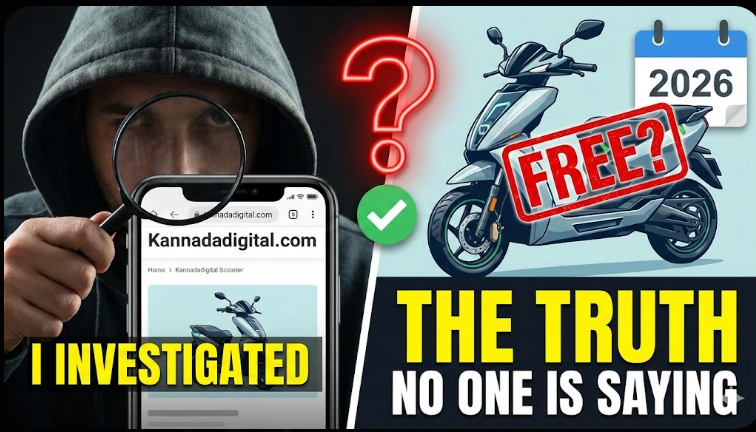
When I first saw the Kannadadigital.com free scooty reel going viral on Instagram, I’ll be honest — even I paused.
Not because I believed it immediately, but because thousands of people were commenting “Applied ✅” and tagging friends. As someone who has reviewed digital schemes, viral websites, and monetization models for years, this triggered my instinct.
So I decided to personally investigate Kannadadigital.com in 2026 — not emotionally, but practically.
This blog is the result of that investigation.
No drama.
No exaggeration.
Just facts, patterns, and logic.
Why I Decided to Check Kannadadigital.com
Here was the problem I noticed:
- Viral Instagram reels claiming “Free Scooty for students / women”
- A simple call-to-action: visit kannadadigital.com and apply
- No clear government logo
- No official documentation shown
- Heavy emotional language in reels
As a blogger, I’ve learned one thing the hard way:
If something spreads fast but explains little, it deserves scrutiny.
So I clicked. I applied. I observed.
What Is Kannadadigital.com Actually Claiming?
From the Instagram reels and website flow, the claim looks like this:
- Free scooty for eligible users
- Just fill a form
- Limited time
- Many beneficiaries shown (but not verified)
At first glance, it feels similar to government welfare-style announcements, which is why many people trust it.
But trust should be based on structure, not emotions.
What I Found After Visiting Kannadadigital.com
Here’s what actually happens step-by-step:
- You land on an article-style page
- The content talks about a “free scooty scheme”
- You’re asked to scroll
- Multiple advertisements appear
- A form or redirection is shown
- No confirmation, no tracking, no follow-up
That’s where the red flags begin.
Important Observation (From First-Hand Experience)
I did not find:
- Any official government department name
- Any scheme notification number
- Any PDF circular
- Any press release
- Any verifiable beneficiary list
What I did find?
👉 Heavy ad placement throughout the page.
Comparison: Kannadadigital.com vs Real Government Scheme Pages
| Factor | Kannadadigital.com | Genuine Scheme Websites |
|---|---|---|
| Official department name | ❌ Not shown | ✅ Clearly mentioned |
| Scheme notification PDF | ❌ Missing | ✅ Available |
| Contact details | ❌ Vague / none | ✅ Office details |
| Ads presence | ⚠️ Very high | ✅ Low or none |
| Application tracking | ❌ Not available | ✅ Application ID |
| Government logo usage | ❌ Absent | ✅ Proper branding |
This comparison alone tells a lot.
Pro Tip #1
Real welfare schemes explain eligibility first, not urgency.
Urgency without clarity is usually a traffic tactic.
Are the Instagram Reels Fake or Misleading?
Let me be precise with words.
The reels are misleading, not informative.
Here’s why:
- They show results, not process
- They show benefits, not authority
- They create urgency but avoid accountability
Most reels use emotional triggers like:
- “Girls don’t miss this”
- “Students apply fast”
- “Government giving free scooty”
But none show proof of government association.
How Kannadadigital.com Likely Makes Money
This is the most important part — and very few people talk about it.
From my observation, the website primarily earns through:
- Display advertisements
- High page scroll time
- Viral traffic from Instagram
The model works like this:
- Viral reel → curiosity
- Website visit → ads load
- User scrolls → more ads
- Revenue generated
Whether you get a scooty or not doesn’t affect their earnings.
Your attention does.
Pro Tip #2
If a website benefits the moment you scroll — but you gain nothing measurable — pause and rethink.
Is There Any Proof of Free Scooty Delivery?
I actively searched for:
- News articles
- Verified testimonials
- Government confirmations
- Independent reviews
As of 2026, I found no credible proof that:
- Scooties are being distributed by Kannadadigital.com
- Applications lead to actual delivery
- Any authority is backing this claim
If you find only reels and no documentation, that’s a signal.
Why People Still Believe It (Psychology Explained)
This is not about intelligence — it’s about emotion.
People believe such claims because:
- Rising vehicle costs
- Youth unemployment stress
- Trust in government schemes
- Social proof via comments
- Fear of missing out
Understanding this helps you stay alert, not ashamed.
Pro Tip #3
Scams don’t look dangerous anymore. They look helpful.
Is Kannadadigital.com Illegal?
I want to be responsible here.
I am not labeling the site illegal.
But I can confidently say:
- The free scooty claim is not transparently supported
- The process lacks official structure
- The content appears designed mainly for traffic and ads
That makes it unreliable, not trustworthy.
What To Do If You Already Applied
If you already filled any form:
- Don’t panic
- Avoid sharing further details
- Don’t pay any money
- Don’t forward the reel
- Follow official government portals only
No legitimate scheme asks for urgency without proof.
Information Gain (2026-Specific Insights)
Here’s what I’ve learned in 2026 after reviewing dozens of viral schemes:
- Viral reels are now lead generators
- Ads-based websites use welfare keywords
- Emotional language outperforms facts
- Verification is intentionally made difficult
- Comments are often unmoderated
- Real schemes move slowly, not virally
- Government pages prioritize PDFs
- Ads-heavy layouts signal monetization intent
- Forms without tracking are meaningless
- Attention is the real currency
Pro Tip #4
In 2026, misinformation is optimized for engagement, not lies.
My Final Verdict: Fake or Real?
Let me be very clear.
Based on my first-hand investigation:
👉 The free scooty claim promoted by Kannadadigital.com via Instagram reels is not real or verifiable.
The website primarily functions as an ad-driven content platform, not a welfare distribution portal.
Final Checklist Before You Trust Any “Free Scheme” Online
Use this checklist every time:
✔ Check official department name
✔ Look for government notification PDF
✔ Search scheme on official portals
✔ Verify contact details
✔ Check if ads dominate the page
✔ Avoid urgency-based language
✔ Never pay fees
✔ Don’t rely only on reels
✔ Cross-check with news sources
✔ Trust structure over emotion
Closing Thoughts
I didn’t write this blog to scare anyone.
I wrote it because digital awareness is the real benefit in 2026.
Radha Krishna bhakti has always been the center of my life, and that’s why I founded Radhajap.in. I’m Vikas, and I believe in the divine power of Naam Jap to transform hearts and bring us closer to Radha Krishna. Through Radhajap.in, I aim to inspire every devotee to embrace a life filled with love, devotion, and the bliss of chanting.