
Not every spiritual lesson arrives in a sermon.
Some of the deepest teachings in the Braj tradition are hidden inside what look like simple, almost playful stories. Stories about cows, flutes, rivers, stolen butter — and yes, bees.
The story of Radha and the bees is one I had heard mentioned in passing several times before I finally sat with it properly. When I did, I realised it was not a children’s tale. It was a complete philosophy of devotion dressed in a garden scene.
Let me share the story first. Then we will go deeper.
The Story
One afternoon in Vrindavan, Radha and Her sakhis (companions) were walking through a garden of blooming flowers. The air was thick with fragrance. Bees were everywhere — drawn helplessly to the blossoms, hovering, circling, unable to leave.
One of Radha’s sakhis — Lalita, known for her sharp wit — turned to Radha and said:
“Sakhi, look at these bees. They have no choice, do they? The flower does nothing — just blooms — and the bee cannot stay away. Is it the flower’s doing, or the bee’s nature?”
Why Radha’s Name Is Always Taken Before Krishna — The Real Spiritual Meaning
Radha smiled but said nothing.
Lalita continued, her voice now carrying a gentle tease: “Just like a certain flute player we know. He does nothing. Simply stands under a kadamba tree and plays. And a certain someone — who has sworn to remain unaffected — cannot seem to stop turning her head in His direction.”
The other sakhis burst into laughter. Radha turned away, pretending to be interested in a flower.
But then — quietly, almost to herself — She said:
“You are wrong, Lalita. The bee goes to the flower because it wants the honey. It uses the flower. The flower receives nothing — it only gives. That is not love. That is need.”
The sakhis fell silent.
Radha continued: “True love is when you are drawn not by what you will receive, but by what you cannot help but offer. The bee takes. I only know how to give. And that is why I cannot stay away.”
Nobody laughed after that.
The Surface Reading and Why It Misses the Point
On the surface, this story might seem like a romantic moment — Radha defending Her love for Krishna against gentle teasing. And yes, it is that.
But the saints of the Braj tradition did not preserve and repeat this story for its romance. They preserved it because Radha’s final words contain one of the most precise definitions of pure bhakti ever spoken.
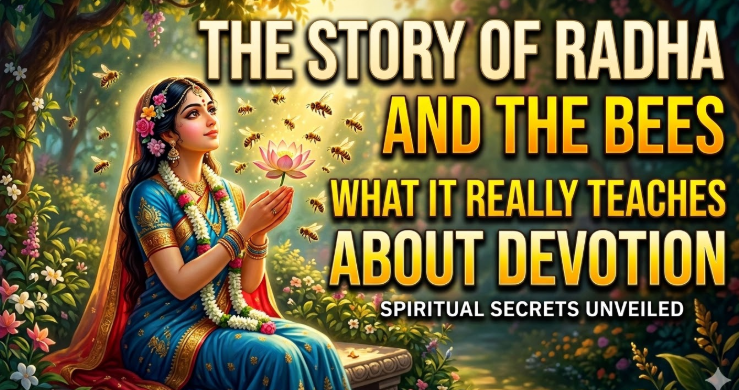
Let us look at it carefully.
The Bee and the Flower — Two Models of Relationship
Lalita presents the bee-and-flower as a metaphor for the devotee and the divine. The bee (devotee) is drawn to the flower (Krishna) — irresistibly, helplessly. She means it affectionately. She is teasing Radha about Her obvious love.
But Radha rejects the metaphor entirely. And Her reason is stunning.
The bee, She points out, comes for honey. It comes for what it will receive. The flower is merely the source of something the bee wants.
This is a description of transactional spirituality — prayers offered in exchange for blessings, devotion performed in hopes of liberation, jap done to earn merit. The divine is the means. The devotee’s own gain is the end.
Radha is saying: that is not what I have with Krishna. That is not bhakti.
“I Only Know How to Give”
Radha’s self-description is radical.
“I only know how to give.” Not: I love Krishna because He is beautiful (though He is). Not: I love Krishna because being near Him fills me with joy (though it does). Not even: I love Krishna because He loves me.
She loves because she cannot not love. Because her entire being has become nothing but the act of loving. She has no agenda in it. No desired outcome. No self to protect or satisfy.
In Sanskrit philosophy, this is called nishkama bhakti — desireless devotion. The highest form. The form that does not even desire union with the divine as a reward, because any desire — even for the divine — is still a form of the small self asserting its wants.
Radha has gone beyond even that. Her love is not a path to Krishna. Her love is simply what She is.
What This Means for Ordinary Devotees Like Us
Here is where I want to be honest, because I think this teaching can be misunderstood.
When we hear “love without desire” or “give without wanting anything back,” it is easy to either dismiss it as an impossible ideal or to feel guilty for having any desires at all in our spiritual practice.
But the saints do not present Radha’s example as a standard you must immediately meet. They present it as the direction to face.
Most of us begin our spiritual life as the bee. We come to jap because we are anxious, unhappy, lost, or wanting something. We come to the divine with our needs. And that is fine. That is human. That is where the path starts.
The teaching of this story is not: stop wanting things. The teaching is: notice what is driving your devotion, and let it slowly, over time, become something purer. Let the honey-seeking gradually give way to something else — a pull that has no purpose beyond itself.
That shift does not happen through effort or self-improvement. It happens through repetition of the name. Through sitting with Radha’s example. Through, slowly, loving the practice more than you love what the practice might give you.
The Bees Are Not Villains
One more thing — and this is important.
Radha does not condemn the bees. She does not say they are wrong or spiritually inferior. She simply distinguishes their relationship from Her own.
In Braj theology, even the bee’s helpless attraction to the flower is a form of Krishna’s magnetism at work in the world. Krishna is so beautiful, so complete, so full — that even the bee’s mundane hunger for honey is, at the deepest level, an expression of the soul’s hunger for the divine.
The bee does not know this. But the pull is real. And real pulls, even unconscious ones, can slowly be understood, refined, and deepened into something more conscious.
You may have come to naam jap for stress relief. Or because your mother told you to. Or because you read something online and were curious. The reason does not disqualify the practice.
The bees came for honey. But they sat in the flowers anyway. And flowers change you just by being near them.
One Practical Thing to Carry From This Story
The next time you sit for jap — or prayer, or any spiritual practice — try asking yourself quietly, without judgment:
What am I here for today?
Am I here because I want something (peace, blessings, relief, merit)?
Or am I here simply because something in me needs to say the name?
You may find different answers on different days. Both are honest. Both are valid.
But slowly — over months and years of asking this question — something begins to shift. The days when you come with nothing to ask, when you sit down simply because you love to say the name, will become more frequent.
That is the direction of Radha’s example. Not perfection. Just direction.
Final Thought
Vrindavan is full of bees. Full of blooming flowers. Full of the sound of a flute that drifts across the Yamuna on certain evenings and makes something in your chest ache in a way you cannot explain.
The whole of Braj is built on a teaching disguised as beauty.
The story of Radha and the bees is one small door into that world. But like all doors in Vrindavan, once you step through it, you find yourself somewhere much larger than you expected.
Come for the honey if you must. The flowers do not mind.
They will do their work anyway.
Radhe Radhe 🙏

I’m Ankita, and I love everything about Radha Krishna bhakti. Naam Jap is a daily part of my life, and Radhajap.in is my way of sharing that love and devotion with others.