
For the modern seeker, time is the scarcest currency. We juggle work, family responsibilities, physical health, and social obligations, leaving only a small fraction of our day for active spiritual practice (Sadhana). If you strive to chant the holy name of Radha Rani (Radha Naam Jap), you might often feel a deep, lingering sense of regret: “I want to chant more, but my day is simply too short.”
Now, consider this: an average human spends approximately 6 to 8 hours a day sleeping. Over a lifetime, this equates to roughly 20 to 25 years of complete darkness, unconsciousness, and spiritual stagnation.
But what if these 6 hours of sleep did not represent a spiritual pause? What if they could be converted into a continuous, flowing river of nectar?
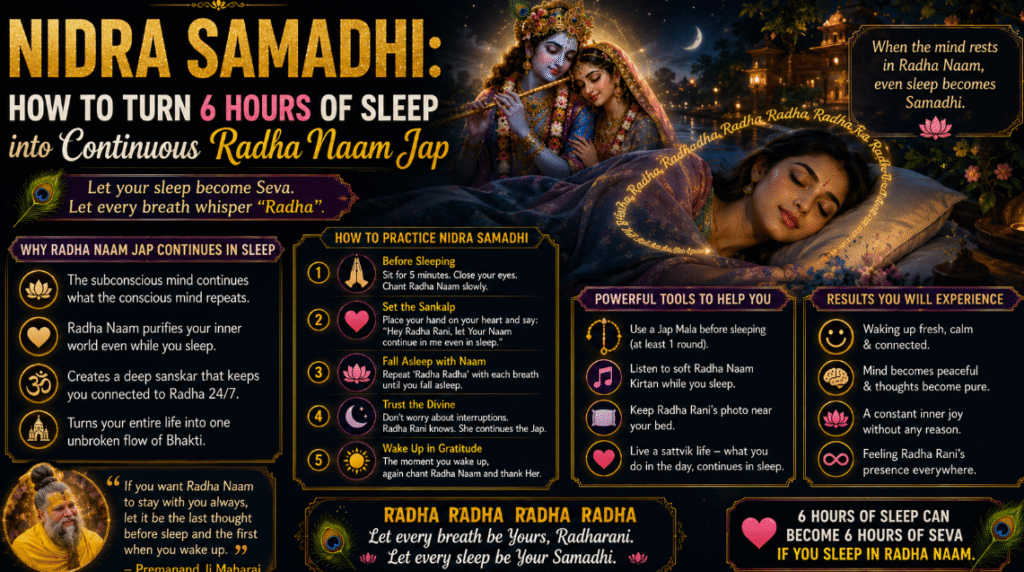
In the ancient secrets of Bhakti Yoga and Vedic psychology, this state of conscious, transcendental sleep is known as Nidra Samadhi. By mastering this art, your physical body gets the deep rest it needs, while your inner soul remains awake, vibrant, and actively submerged in the sweet, purifying waves of Radha Naam Jap.
What is Nidra Samadhi? (The Meeting of Rest and Bhakti)
In traditional yoga systems, sleep (Nidra) is defined by Patanjali as a mental modification based on the absence of active cognitive content. It is generally a state of Tamas (inertia and ignorance). Samadhi, conversely, is the pinnacle of spiritual absorption (Sattva and beyond).
To the untrained mind, Nidra and Samadhi are polar opposites. But for a devotee of Sri Radha, they can merge.
[ Conscious Waking Mind ]
           │
           ▼  (Transition State: Hypnagogia)
[ Subconscious Mind ]  ◄─── Seeded with: "Radha... Radha... Radha..."
           │
           ▼  (Deep Sleep State)
[ Nidra Samadhi / Ajapa Japa ]
Nidra Samadhi occurs when the subconscious mind becomes so saturated with the transcendental sound vibration of Radha Naam during your waking hours—and especially during the critical moments before sleep—that the chanting continues automatically on a deep, subliminal level throughout the entire sleep cycle. It transitions from active Jap (effortful chanting) to Ajapa Japa (effortless, automatic, perpetual chanting).
Free Online Radha Naam Jap Counter – Chant with Devotion, Count with Ease
The Science of the Subconscious: The Hypnagogic Gateway
To understand how to program your sleep, we must look at modern neuroscience. As you transition from wakefulness to deep sleep, your brain waves undergo a rapid, sequential shift:
- Beta Waves ($12\text{ Hz}$ – $30\text{ Hz}$): High frequency, active thinking, logical, awake.
- Alpha Waves ($8\text{ Hz}$ – $12\text{ Hz}$): Relaxed, reflective, peaceful, daydreaming.
- Theta Waves ($4\text{ Hz}$ – $8\text{ Hz}$): Deep relaxation, creativity, access to the subconscious mind. This is the hypnagogic state—the golden bridge.
- Delta Waves ($0.5\text{ Hz}$ – $4\text{ Hz}$): Deep, dreamless sleep, physical healing.
The hypnagogic state (Theta zone) lasts for only about 10 to 20 minutes before you fall completely asleep. It is during this precise window that the analytical filter of your conscious mind turns off, leaving the doorway to your vast subconscious wide open.
Whatever thought, word, or emotion you introduce into your mind during this Theta-wave window is magnified exponentially. If you fall asleep worrying about your finances, your subconscious chews on anxiety for 6 hours. But if you seed this state with the sweet, musical, rhythmic vibration of “Radha… Radha…”, your subconscious adopts it as its primary background process, looping it continuously until you wake up.
The 5-Step Practical Blueprint to Attain Nidra Samadhi
Transitioning your sleep into a holy sanctuary does not happen by accident. It requires a conscious, structured protocol. Follow this highly effective 5-step daily ritual to reprogram your sleep state.
┌─────────────────────────────────────────────────────────┐
│              NIDRA SAMADHI DAILY PROTOCOL               │
├─────────────────────────────────────────────────────────┤
│ Step 1: Shuddhi (Physical & Mental Purification)        │
│ Step 2: Sankalpa (Chanting the Intent Protocol)         │
│ Step 3: Breath-Naam Synchronization (Prana-Naam Sync)  │
│ Step 4: Chid-Akasha Smaran (Visualizing Heart Space)   │
│ Step 5: The Transcendental Handover (Asleep in Radha)  │
└─────────────────────────────────────────────────────────┘
Step 1: Shuddhi (Physical and Digital Purification)
Your sleep environment directly dictates your mental frequency.
- The No-Screen Rule: Turn off all mobile phones, laptops, and televisions at least 30 minutes before your head touches the pillow. Blue light suppresses melatonin and excites beta brainwaves, blocking the path to peaceful sleep.
- Physical Shuddhi: Wash your hands, feet, and face with cool water. If possible, change into clean, light-colored clothing. Sprinkle a few drops of holy Ganga water or rub a small amount of sacred dust (Vraja Raja) on your forehead.
- Aromatic Elevation: Light a natural, mild incense (like sandalwood or jasmine) or use an organic essential oil diffuser. Rhythmic, sweet scents stimulate the limbic system, preparing it for divine contemplation.
Step 2: Sankalpa (The Intent Protocol)
Sit comfortably on your bed, crossing your legs. Close your eyes and take three deep, slow abdominal breaths. Set a clear, conscious spiritual intention (Sankalpa).
Whisper gently to yourself or say internally:
“O Sri Radha, my body and conscious mind are entering rest, but my soul belongs to You. I hand over my mind, breath, and heartbeat to Your holy name. May every breath I draw in my sleep chant Your name, and may my heart beat in unison with You.”
This simple act of setting a conscious intention acts as an instruction booklet for your subconscious mind, guiding its processes during deep sleep.
Step 3: Breath-Naam Synchronization (Prana-Naam Sync)
Lie down in a comfortable position. The ideal posture for this is Shavasana (corpse pose) or lying on your left side (which activates the Ida Nadi, the cooling, lunar energy channel associated with peace and devotion).
Begin to slow down your breathing, making it deep, silent, and rhythmic. Now, synchronize the holy name of Radha with your breathing:
- As you inhale deeply, chant internally:
Ra-a-a-a(feeling the divine energy enter your chest). - As you exhale fully, chant internally:
Dha-a-a-a(feeling all worldly attachments, anxieties, and impurities leave your body).
Let the syllables stretch to match the length of your breath.$$\text{Inhale} \rightarrow \text{“RA”} \quad | \quad \text{Exhale} \rightarrow \text{“DHA”}$$
Do not force your breath; let it find its natural, peaceful rhythm. The name should dance effortlessly on the waves of your breath.
Step 4: Chid-Akasha Smaran (Visualizing inside the Heart Space)
As you chant with your breath, shift your inner gaze (Drishti) to your heart center (Anahata Chakra). Visualize a brilliant, glowing golden lotus inside your heart.
See the name “राधा” engraved on the petals of this golden lotus in sparkling, glowing letters of light. As you breathe in Ra and breathe out Dha, visualize waves of golden light radiating from this lotus, filling your entire body, blood vessels, and nervous system with the ecstatic nectar of devotion.
Step 5: The Transcendental Handover (Falling Asleep Mid-Chant)
This is the most critical step. Your goal is to slip across the border of wakefulness into deep sleep while actively chanting.
Do not try to “finish” a certain number of rounds. Do not worry about keeping count on your fingers or a bead bag. Simply dissolve your mind into the sweet sound vibration of Ra-Dha. Let the chant become softer, more internal, and more delicate as your eyelids grow heavy.
Let the transition happen organically. Waking awareness will fade, but the last conscious print left on your brain will be the sweet name of Radha. Your subconscious will grab this print and loop it continuously for the next 6 hours.
The Metaphysics of Sleep Chanting: How it Cleanses Karmas
Why is Nidra Samadhi so immensely powerful?
According to scriptural wisdom, our subconscious mind is a vast reservoir of past impressions (Samskaras), suppressed desires (Vasanas), and accumulated karmic records. When we sleep, these impressions bubble up to the surface in the form of wild, chaotic, or anxious dreams.
When you practice Nidra Samadhi, the holy name acts as a spiritual laser. By introducing the high-frequency transcendental sound wave of Radha Naam into your subconscious during sleep, you are systematically neutralising lifetimes of negative karmic impressions.
[ Deep Subconscious Layer ]  ◄── Contains: Karmas, Fears, Samskaras
          ▲
          │ (Neutralization Process)
[ High-Frequency Radha Naam ] ◄── Introduced via Nidra Samadhi
Instead of generating new worldly anxieties or experiencing karmic debts through nightmares, your soul is continuously bathed in the pure, unadulterated nectar of Bhakti-rasa. This is why devotees who practice Nidra Samadhi often find that their waking minds are naturally calmer, less prone to anger, and deeply anchored in peace during the day.
Clear Signs of Attaining Nidra Samadhi
How do you know if your practice is succeeding? Look for these beautiful spiritual and physical markers in your life:
- The Wake-Up Chant: The moment you open your eyes in the morning, the name “Radha” is already echoing inside your mind or resting gently on your lips, even before your conscious brain fully realizes where you are.
- Divine, Peaceful Dreams: Your chaotic, stressful, or worldly dreams fade away. They are replaced by peaceful, divine dreams of temples, saintly associations, holy rivers (like the Yamuna), or beautiful natural landscapes.
- Reduced Need for Sleep: You wake up feeling incredibly refreshed and energized, even if you slept only for 5 or 6 hours. This is because your nervous system was completely relaxed and free from psychological stress during sleep.
- Natural Alertness: You no longer wake up with a heavy, groggy mind (Tamas). Instead, your mind feels clean, crisp, and spiritually alert immediately upon waking.
- Continuous Remembrance: During the busy hours of your day, you will suddenly find a gentle, background current of Radha Naam running automatically inside your mind, even while you are working or studying.
Overcoming Common Obstacles
| Obstacle | Root Cause | Solution |
|---|---|---|
| Mind Wanders Before Sleep | Overstimulation of the brain due to daytime worries or late-night screen time. | Do 10 minutes of slow chanting aloud before lying down. Write your worries on a paper to “dump” them before starting the practice. |
| Groggy Waking/Forgetfulness | High toxic load in body or eating a heavy, late dinner. | Eat a light, Sattvic dinner at least 3 hours before sleep. Avoid processed foods, caffeine, or heavy sweets at night. |
| Intense Nightmare/Disturbance | Purging of deep-rooted negative subconscious samskaras. | Do not be afraid. This is a cleansing process. Keep a glass of water nearby, chant Radha Naam aloud, and reset your Sankalpa. |
Conclusion: Turn Every Night into a Pilgrimage
Sleep is not a waste of time; it is a sacred portal. By mastering Nidra Samadhi, you reclaim a third of your life for active, sweet devotion. Your bedroom becomes a temple, your bed becomes an altar, and your 6 hours of sleep transform into a continuous, unbroken, sweet meditation on the lotus feet of Sri Radha.
Begin tonight. Purify your space, set your intention, and let the gentle rhythm of your breath carry the most beautiful syllables of the universe deep into your subconscious soul: Ra-Dha… Ra-Dha… Ra-Dha.
Frequently Asked Questions (FAQs)
1. Can beginners practice Nidra Samadhi, or is it only for advanced saints?
Anyone can practice it! While complete, continuous, uninterrupted spiritual realization in sleep is a state achieved by advanced saints (Siddha devotees), the practice of programming your subconscious mind using the hypnagogic state is a highly accessible technique that shows immediate benefits even for absolute beginners.
2. What if I wake up in the middle of the night?
If you wake up, do not check your phone or look at the clock. Simply observe your breath immediately and restart the synchronization: inhale Ra, exhale Dha. Let yourself fall back asleep with the chant. This will deepen the neural pathways of devotion.
3. Does Nidra Samadhi affect the quality of physical rest?
On the contrary, it greatly improves it. When you fall asleep in a state of anxiety or stress, your body remains tense, and you spend less time in restorative deep sleep. Chanting Radha Naam relaxes the parasympathetic nervous system, lowering your heart rate and cortisol levels, which leads to highly restorative and rejuvenating rest.
4. Should I use a bead bag (Japa Mala) while trying to fall asleep?
It is not recommended to use a physical Mala while lying down to sleep, as you might drop it, roll over it, or accidentally disrespect the sacred beads. Instead, transition entirely to internal, mental chanting (Manasa Jap) synchronized with your breath.
5. What is the role of diet in successfully practicing Nidra Samadhi?
Diet plays a massive role. Eating heavy, oily, or non-vegetarian food (Rajasic or Tamasic food) clogs the subtle energy channels (Nadis) and excites the mind, making it impossible to access the calm, subtle Theta-wave state. Eating clean, freshly cooked vegetarian food (Sattvic diet) offered with love to the Lord makes the mind light, peaceful, and highly receptive to divine programming.
Radha Krishna bhakti has always been the center of my life, and that’s why I founded Radhajap.in. I’m Vikas, and I believe in the divine power of Naam Jap to transform hearts and bring us closer to Radha Krishna. Through Radhajap.in, I aim to inspire every devotee to embrace a life filled with love, devotion, and the bliss of chanting.