
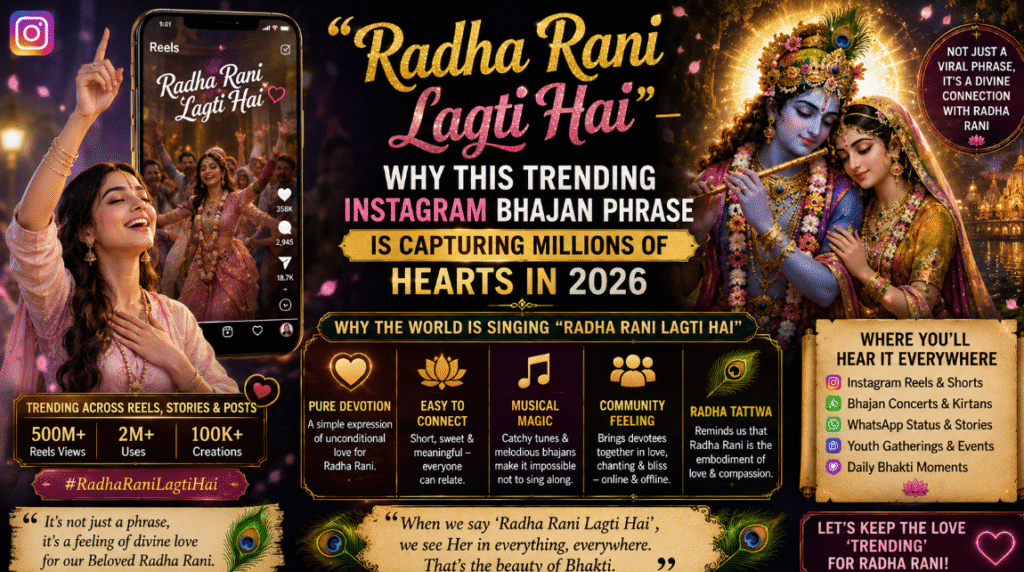
Scroll through Instagram reels in 2026 and within minutes you will likely stumble onto it: a soft bhajan playing in the background, a girl in a flowing pink or peach outfit twirling near a temple courtyard, and a caption that simply reads “Radha Rani Lagti Hai” — she looks like Radha Rani herself. The comment sections are flooded with red hearts, folded-hand emojis, and “Radhe Radhe” written hundreds of times over.
This is not an isolated viral moment. It’s part of a much bigger cultural wave — what creators are now calling “bhajan clubbing” — where devotional music, divine aesthetics, and short-form video have merged into one of the most emotionally resonant trends on Indian social media. And at the center of it sits this one simple, deeply affectionate phrase: Radha Rani Lagti Hai.
In this blog, we explore where this trend came from, why it has struck such a powerful chord in 2026, and what it reveals about how an entire generation is rediscovering bhakti through the most modern medium imaginable — the algorithm.
What Does “Radha Rani Lagti Hai” Actually Mean?
At face value, the phrase translates to “she looks like Radha Rani.” But within devotional culture, this is far more than a compliment about appearance. To be compared to Radha Rani — the eternal consort of Lord Krishna, revered as the embodiment of pure, selfless love and devotion — is considered one of the highest forms of praise a devotee can receive.
When creators use this phrase under a reel, they are rarely making a literal statement about facial resemblance. Instead, it is an emotional reaction to a vibe: the softness of the visuals, the grace of the movement, the colors associated with Vrindavan (rose pink, peach, gold, and deep red), and the devotional mood created by the bhajan playing underneath. It is the internet’s way of saying, “this moment feels divine.”
How the Trend Took Off Across Instagram
The “Radha Rani Lagti Hai” wave did not appear out of nowhere. It grew out of a broader explosion of Krishna and Radha-themed devotional content on Instagram Reels and YouTube Shorts, where hashtags like #radhakrishna, #radharani, #harekrishna, #bhaktivibes, and #bhajanclubbing have collectively racked up enormous engagement throughout 2025 and into 2026.
A major driver of this momentum has been the rise of “bhajan clubbing” — essentially the devotional equivalent of a music mashup or remix culture, where classic kirtans and bhajans are blended with modern beats, cinematic visuals, and aesthetic editing. Popular creators and singers have leaned heavily into this format, producing reels themed around Banke Bihari, Shyam Baba, and Radha Rani that combine soulful vocals with high-production visuals styled like devotional movie posters.
Layered on top of this is a parallel trend of “divine aesthetic” content — creators using soft lighting, temple backdrops, peacock feather motifs, and flowing traditional outfits to recreate the visual mood of Vrindavan itself. When a creator’s reel successfully captures that look and feeling, “Radha Rani Lagti Hai” becomes the natural caption or top comment, almost like a seal of approval from the devotional community.
The timing has also mattered. With festivals like Janmashtami, Radhashtami, and Rath Yatra generating massive seasonal spikes in devotional content every year, phrases tied to Radha Rani consistently resurface and gain fresh traction each time these occasions approach, keeping the trend evergreen rather than a one-off moment.
Why Has This Trend Resonated So Deeply in 2026?
It’s worth asking why a devotional phrase — rather than a comedy sound or a dance trend — has managed to capture this much emotional attention on a platform usually associated with entertainment and humor.
1. Bhakti has become aspirational, not old-fashioned.
A noticeable cultural shift has taken place where devotion to Krishna and Radha is no longer seen as something only older generations practice. Younger users are actively choosing devotional aesthetics for their personal brand and content identity, treating bhakti as something stylish, comforting, and emotionally grounding rather than outdated.
2. Short-form video matches the emotional rhythm of bhajans.
Bhajans build emotion in waves, and a 15 to 30 second reel can capture that swell of feeling perfectly — a soft beginning, a rising chorus, and a release that lands right as the visual peaks. The format and the music genre were, in a sense, made for each other.
3. It offers an emotional escape from algorithm fatigue.
Many users have described feeling exhausted by constant comedy skits, trends, and produced content. Devotional reels feel different — calmer, warmer, more sincere — offering a moment of peace within an otherwise chaotic feed.
4. Community validation through shared language.
Phrases like “Radha Rani Lagti Hai” function as a kind of devotional shorthand. Typing it in a comment section instantly signals shared values and faith, creating a sense of belonging among strangers who may never interact otherwise.
5. Celebrity and influencer spiritual visibility.
With public figures increasingly open about their devotion to Radha Krishna and their visits to places like Vrindavan, devotional content has gained a kind of cultural permission it didn’t always have on mainstream social platforms.
The Deeper Spiritual Layer Behind the Viral Moment
While it’s easy to view this purely as an internet trend, there is a genuine spiritual current running underneath it. Radha Rani is not simply a mythological figure in Vaishnava tradition — she represents the highest ideal of bhakti, a love so complete and selfless that it asks for nothing in return. For centuries, saints and poets in the Bhakti movement have described the goal of devotion as cultivating even a fraction of Radha’s love for Krishna.
Seen through that lens, the viral phrase becomes something more meaningful than internet slang. Every time someone writes “Radha Rani Lagti Hai” under a reel, they are — even unconsciously — invoking centuries of devotional philosophy and pointing toward an ideal of pure love and surrender. The trend may be modern, but the emotional and spiritual root it taps into is ancient.
This is also why so much of this content naturally pairs with naam jap and kirtan audio rather than mainstream music. The phrase doesn’t just compliment appearance — it elevates a fleeting digital moment into something that feels, even briefly, sacred.
From Vrindavan’s Ghats to Your Phone Screen
What makes this trend particularly interesting is the geography behind it. A large share of the most-shared “Radha Rani Lagti Hai” reels are filmed in or styled after real locations tied to Radha and Krishna’s life — the kunjas of Vrindavan, the ghats along the Yamuna, the courtyards of temples like Banke Bihari and Prem Mandir, and the open fields of Barsana, believed to be Radha Rani’s birthplace. Creators travelling to these towns for personal pilgrimage often end up producing some of the most viral content almost by accident, simply because the visual backdrop already carries centuries of devotional history.
This blending of real sacred geography with digital virality has an interesting side effect: it is quietly driving renewed interest in spiritual tourism to Braj Bhoomi. Many users comment asking for location details, travel tips, or the best time to visit for darshan, turning a purely digital trend into something that nudges people toward an actual physical and spiritual journey.
It also explains why the trend feels different from typical viral content. A dance trend or comedy skit usually has no real-world destination attached to it. This one does — and for many devotees, the reel is simply the first step before the real pilgrimage.
How You Can Be Part of the Trend Meaningfully
If you want to participate in this trend in a way that goes beyond aesthetics, consider grounding it in genuine devotion rather than just visual appeal.
Choose bhajans and kirtans dedicated specifically to Radha Rani, such as those centered on her names and pastimes in Vrindavan, rather than generic devotional audio. Pair your content with a short, sincere caption about what devotion means to you, rather than relying only on the trending phrase. Use the moment as an entry point to learn more about Radha Rani’s significance in Vaishnava philosophy, not just as a passing aesthetic. Treat the comment section kindly, since many people engaging with this content are genuinely processing real emotions, comfort, and faith through it.
Frequently Asked Questions
Q1: What does “Radha Rani Lagti Hai” mean?
It translates to “she looks like Radha Rani” and is used as a high form of devotional praise on social media, complimenting someone’s grace, aesthetic, or divine vibe rather than literal appearance.
Q2: Why is this phrase trending on Instagram in 2026?
It has grown alongside the broader “bhajan clubbing” and devotional aesthetic trend, where creators combine kirtans, soft visuals, and Vrindavan-inspired styling in reels, with the phrase used as a caption or top comment of approval.
Q3: Is this trend only about appearance?
No. While it often comments on visual aesthetics, the phrase carries deeper devotional meaning rooted in Radha Rani’s symbolic status as the embodiment of pure love and bhakti in Vaishnava tradition.
Q4: What is “bhajan clubbing”?
It refers to the trend of blending traditional bhajans and kirtans with modern music production, cinematic editing, and short-form video formats to create emotionally engaging devotional reels.
Q5: How can I use this trend respectfully?
Pair it with genuine devotional audio dedicated to Radha Rani, add a sincere caption, and treat it as an opportunity to explore deeper bhakti rather than purely chasing views.
Final Thoughts
“Radha Rani Lagti Hai” may have started as a viral caption, but its staying power in 2026 comes from something far older than any algorithm — a collective, almost instinctive longing to touch something pure, devotional, and divine, even in the middle of an Instagram scroll. As bhajan clubbing and devotional aesthetics continue to grow, this phrase stands as a small but powerful reminder that bhakti has found a new home, one reel at a time.
🙏 Radhe Radhe 🙏
Radha Krishna bhakti has always been the center of my life, and that’s why I founded Radhajap.in. I’m Vikas, and I believe in the divine power of Naam Jap to transform hearts and bring us closer to Radha Krishna. Through Radhajap.in, I aim to inspire every devotee to embrace a life filled with love, devotion, and the bliss of chanting.