
Sometime in late 2024, a video went viral on Instagram Reels. Hundreds of young men and women — most of them in their 20s — were dancing with their eyes closed, arms raised, drenched in colour, inside what looked like a warehouse venue. But there was no DJ drop, no EDM bass. What they were moving to was a live kirtan, pulsing with dholak, harmonium, and the chant of “Radhe Radhe.”
That video was a window into something quietly extraordinary — a cultural shift that we at RadhaJap.in have been watching unfold over the past two years. Across India’s metros and now its tier-2 cities, a new kind of event has taken root. People are calling it Bhajan Clubbing. And it is changing the conversation about what spirituality looks like for a generation that grew up on Spotify.
What Is Bhajan Clubbing?
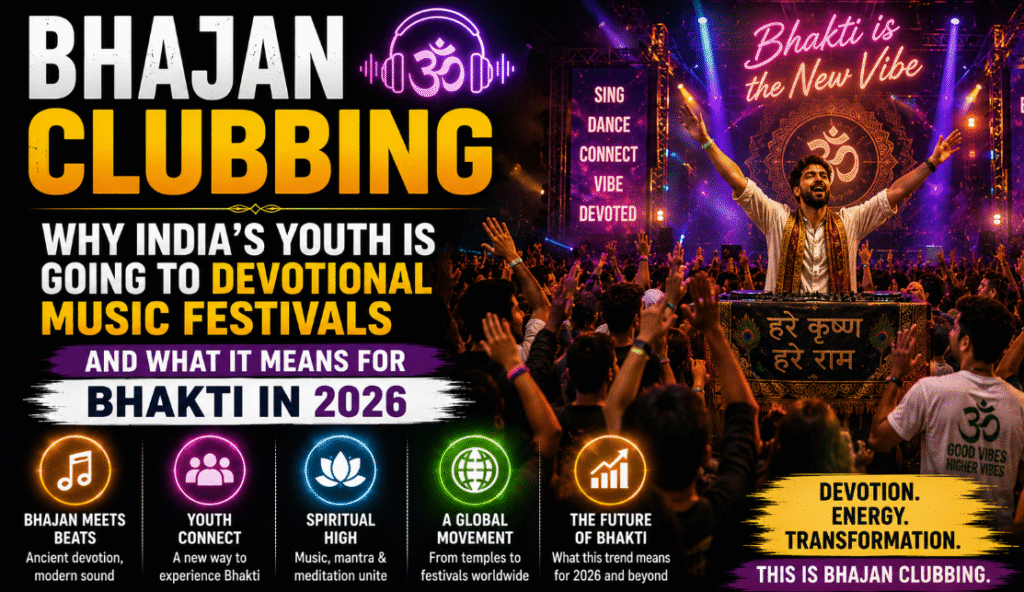
Bhajan Clubbing is not a formal term coined by religious institutions. It emerged organically — first in social media captions, then in event listings — to describe devotional music events that are designed with the energy and aesthetics of a music festival or nightclub, but centred entirely around bhajans, kirtans, and Naam Jap.
Think: atmospheric lighting, live musicians performing for two to three hours, a young crowd singing along, vendors selling prasad and chai, and a DJ-less night that somehow still feels electric. Events like Naam Raas in Mumbai, Kirtan Nights in Bengaluru, and Raas Mahotsav pop-ups in Delhi have drawn thousands. Instagram searches for ‘kirtan night’ and ‘bhajan festival 2026’ have grown sharply this year, and organisers report waitlists for well-produced events.
Why Is This Happening Now?
1. Post-Pandemic Spiritual Seeking
The COVID years forced millions of Indians into introspection. Many rediscovered their grandparents’ bhajan books, found comfort in Hanuman Chalisa recordings on YouTube, or began chanting as a form of anxiety management. That private seeking has now moved outward. The bhajan clubbing phenomenon is, in many ways, the public expression of a private spiritual revival.
2. Community Hunger in an Isolated Generation
Gen Z and younger Millennials report higher rates of loneliness than any previous generation, despite — or perhaps because of — constant digital connection. Devotional music events offer something algorithms cannot: the experience of chanting in a room full of people who are all present, all opening up at the same time. Satsang, in its oldest sense, has always been about exactly this.
3. The Aesthetics Have Changed
It would be dishonest to pretend aesthetics play no role. Young people come when events are beautiful — when there is good light design, professional sound, and a curated atmosphere. The organisers of bhajan clubbing events have understood this. They are not dumbing down the devotion; they are presenting it in a form that speaks to their audience’s visual language. The bhajans themselves are unchanged. Mirabai, Surdas, Kabir still speak. Only the stage has been redesigned.
4. Social Media as Satsang Amplifier
YouTube channels devoted to bhakti music have accumulated tens of millions of subscribers. Artists like Anup Jalota, Jubin Nautiyal covering bhajans, and independent kirtan collectives have massive followings on Instagram and Spotify. When an event is Reels-worthy, attendance follows. The modern satsangi discovers events on their phone, but the experience they find there is ancient.
What Happens at a Bhajan Clubbing Event?
Having spoken to attendees at several such events and followed communities online, here is what a typical evening looks like:
- Doors open at 6:30 or 7 PM. There is usually an altar with flowers, diyas, and an image of the presiding deity.
- A group of musicians — typically five to eight, including harmonium, tabla, dholak, and sometimes sitar or electric guitar — begins with a slow, meditative aarti or stuti.
- Over ninety minutes, the energy builds. Ragas give way to faster paced bhajans. The audience, which began seated, is now on its feet.
- Peak energy arrives with group Naam Jap — often Hare Krishna mahamantra, or Radhe Radhe — chanted in call-and-response, sometimes for twenty to thirty unbroken minutes.
- The evening closes with a slow return to stillness. Prasad is distributed. People linger.
What is consistently reported by those who attend: a feeling of deep emotional release. Tears. Lightness. A sense of coming home.
What Does This Mean for Bhakti in 2026?
“Bhakti has never needed a building. It needs a beating heart. And right now, India’s young people are offering theirs.”
For those of us who have practised Naam Jap and bhakti sadhana for years, this trend is not a dilution. It is a remembering. Bhakti has always been a democratic, accessible, embodied path — Lord Chaitanya’s sankirtan movement in the 15th century was itself a form of public, ecstatic devotion that was considered radical by the orthodoxy of its time.
What is significant is that the younger generation is not being handed bhakti by their parents or their temples. They are finding it themselves — through events, through YouTube, through their own spiritual hunger. That self-directed seeking, Vaishnavas would say, is precisely how Radha’s grace works. She draws people to Her by whatever path opens before them.
Is There a Shadow Side?
It is worth asking the honest question: can Bhakti become commodified? Can an event that charges a ticketing fee and promotes itself through social media truly deliver the fruits of satsang?
The answer, I think, lies not in the format but in the intention. Naam Jap taken in a beautifully lit venue is still Naam Jap. Kirtan performed by sincere devotees moves the heart regardless of the venue. The risk — and it is a real one — is when the event becomes performance rather than participation, when attendees are spectators of devotion rather than participants in it. The best organisers understand this distinction and design their events to dissolve it.
How Can You Participate?
If you are drawn to this movement, here is how to engage authentically:
- Look for events in your city using Instagram, Patreon devotional circles, or ISKCON community pages.
- Arrive early. The pre-event atmosphere — when musicians are tuning up and diyas are being lit — is itself a meditation.
- Come prepared to chant, not just watch. Bring a mala if you have one.
- After the event, continue the energy at home. Even ten minutes of Radhe Radhe jap before sleep carries the blessing of the evening forward.
- Follow up by reading about the bhajans sung — their poets, their meanings. Bhakti deepens with understanding.
The Bottom Line
Bhajan Clubbing is not a trend that will peak and fade. It is a symptom of something deeper: a generation’s need for genuine spiritual community and embodied devotion in a world that has become thin on both. For Bhakti culture, this moment is an extraordinary opportunity — not to modernise the tradition, but to make it available to those who are already reaching for it.
At RadhaJap.in, we believe Naam Jap is the simplest and most powerful doorway. Whether you first encounter it in a lit-up kirtan hall or in the quiet of your own home, the Name carries you forward. Radhe Radhe.
Radha Krishna bhakti has always been the center of my life, and that’s why I founded Radhajap.in. I’m Vikas, and I believe in the divine power of Naam Jap to transform hearts and bring us closer to Radha Krishna. Through Radhajap.in, I aim to inspire every devotee to embrace a life filled with love, devotion, and the bliss of chanting.