
One of the most consistent things I have observed over years of discussing spiritual practice with other devotees is this: the people who maintain a daily naam jap habit almost always have a dedicated space for it. And the people who struggle to maintain consistency almost never do.
This is not a coincidence.
A dedicated puja space does something that no amount of willpower can fully replace. It creates a physical anchor for your practice. Over time, simply entering that corner of your home — seeing the lamp, smelling the incense, seeing Radha Rani’s image — begins to shift your inner state before you have even sat down. The body learns. The mind responds to environment in ways deeper than intention.
This guide is for anyone who wants to create that space — whether you live in a large house with a dedicated room or a small apartment with only one corner to spare.
The Core Principle: Sacred, Not Elaborate
The most important thing to understand before anything else is this: the quality of your puja space has almost nothing to do with its size or cost. A simple wooden platform with one photograph, a clay diya, and a small Tulsi plant can be more powerful than an elaborate marble mandir if it is maintained with sincerity and visited daily.
The tradition is consistent on this. Krishna tells Arjuna in the Gita that he accepts a leaf, a flower, a fruit, a little water — offered with devotion. He does not ask for marble. He asks for bhav.
Keep this in mind as you read the rest of this guide. Everything here is guidance, not requirement.
Choosing the Location
If you have a separate room that can become a dedicated puja room, that is ideal. But for most people — especially those in smaller city apartments — this is not possible. A corner of a bedroom, a section of the living room, or a shelf can all work well.
The guidelines from the tradition are practical: choose a clean, quiet corner, preferably facing east or north. Avoid setting up your puja space in a bathroom-adjacent wall, directly opposite the main entrance door, or in an area that gets high foot traffic and noise throughout the day. The energy of the space should feel still, not restless.
Height also matters: the puja space should be at a level where you can see the image of Radha Rani at eye level when you are seated. Neither looking up steeply nor looking down at the deity. Eye contact — even with a photograph — creates a different quality of attention than looking at an image from an awkward angle.
What You Actually Need — The Essentials
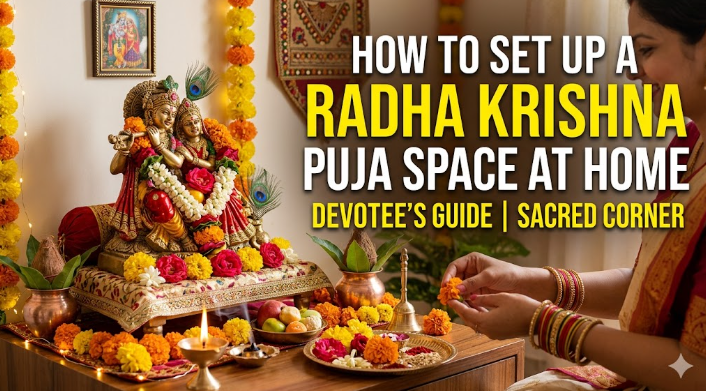
The image or murti of Radha Krishna
This is the heart of the space. For a Radha naam devotee, the image should ideally show Radha and Krishna together — Radha on the left of Krishna (from the viewer’s perspective), as is the traditional arrangement. The Yugal Sarkar — the divine couple — is the central object of worship in this tradition.
Whether you use a framed photograph, a printed picture in a simple frame, or a brass or marble murti is entirely your choice and budget. What matters is that the image is clear, well-maintained, and that you feel a genuine pull toward it when you look at it. If a particular image does not feel alive to you, find one that does.
The lamp
A simple clay diya or a brass deepak is sufficient. For daily use, a ghee lamp is considered most sacred in the Vaishnava tradition — clarified butter (ghee) is traditionally used, with a cotton wick. If ghee is not available daily, pure sesame oil or coconut oil is acceptable. A camphor lamp (karpur aarti) can be kept for special occasions or the main aarti moments.
Incense
The sense of smell has an unusually powerful connection to memory and inner state. Burning a stick of incense — gugal, sandalwood, or any fragrance you associate with devotion — before sitting for naam jap creates a sensory cue that, over time, becomes a powerful trigger for meditative attention. Keep the variety consistent: using the same fragrance repeatedly builds the association more strongly.
A small bell
Used to signal the beginning and end of your puja time. The bell sound clears the atmosphere of the space and signals the transition from ordinary mind to devotional attention. Even a small brass bell is sufficient.
A Tulsi plant
If your space allows for it, keeping a Tulsi plant adjacent to your puja space is deeply traditional and genuinely beneficial. Tulsi purifies the atmosphere of the room and is considered the most sacred plant in the Vaishnava tradition. A small pot near the puja shelf is sufficient. Water it daily, offer it a lamp in the evening, and treat it with the respect you would give any sacred presence in your home.
What is Optional but Deeply Enriching
A gomukhi bag for your mala — keeps your Tulsi mala protected and ensures the counting remains private, which is traditional.
A small copper or brass water vessel (kalash) — represents the presence of all sacred rivers and is kept filled with fresh water on the puja shelf.
A chandan (sandalwood paste) stick — for applying tilak before sitting for puja, a practice that physically marks the transition into devotional time.
A small conch shell (shankh) — blown at the beginning of aarti. Its sound is considered auspicious and purifying for the space.
Seasonal flowers — fresh flowers offered daily to Radha Rani are one of the simplest and most beautiful forms of seva. Even a single flower, replaced daily, transforms the atmosphere of the space.
Maintaining the Space — The Practice That Matters Most
A puja space that is set up beautifully once and then neglected becomes a source of subtle guilt rather than inspiration. The most important rule is simple: whatever you set up, maintain it daily.
Daily maintenance takes less than five minutes: remove yesterday’s flowers, wipe the shelf with a clean cloth, refill the water vessel, light the lamp and incense. This brief act of care — repeated every day — is itself a form of seva. It keeps the space alive.
Do not allow non-devotional objects to accumulate on the puja shelf. No bills, no keys, no phone chargers. The space should remain exclusive to its purpose. When visitors come to your home and see that corner of your house clearly dedicated to something sacred, it makes a quiet impression — on them, and on you.
A Note on Not Waiting Until Everything is Perfect
The most common obstacle I see people create for themselves is waiting. “I will set up my puja space properly once I buy the right murti. Once I have painted the wall. Once I have a separate room.”
The tradition does not ask for perfection. It asks for sincerity. Start with what you have — a photograph printed on paper, a clay diya from the market for ten rupees, a stick of incense. Sit before it today. Begin the naam jap today.
The space will grow with your practice. The murti will come. The corner will become a room. But the practice has to come first.
Begin where you are. Begin now.
Radhe Radhe.

Radha Krishna bhakti has always been the center of my life, and that’s why I founded Radhajap.in. I’m Vikas, and I believe in the divine power of Naam Jap to transform hearts and bring us closer to Radha Krishna. Through Radhajap.in, I aim to inspire every devotee to embrace a life filled with love, devotion, and the bliss of chanting.