
You are going about your day — glancing at your phone, it reads 1:08. You pick up a bill, the total is ₹108. You count the beads on a mala, and they number — you guessed it — 108. You notice 108 appearing in your life and wonder: is this a sign? What does it mean? Is 108 an angel number?
The answer is layered, fascinating, and deeply rooted in both ancient wisdom and modern science. Angel number 108 is one of the most powerful and widely recognised numerical sequences in the world — and its significance goes far beyond numerology.
What Are Angel Numbers?
Angel numbers are repeating numerical sequences that are believed — in numerology and spiritual traditions — to carry specific messages from the universe, higher consciousness, or divine guides. People report seeing these numbers at moments of transition, decision, or spiritual opening.
The most common angel numbers are 111, 222, 333, and so on. But 108 occupies a unique position: it is not just a numerological pattern. It is a number that civilisations thousands of years apart have independently recognised as cosmically significant.
The Significance of 108 in Hinduism
In Hindu philosophy, 108 is not merely auspicious — it is considered the number of the universe. Here is why:
1. The Mala (Rosary) Has 108 Beads
A Hindu japa mala has 108 beads. When you complete one full round of Naam Jap — chanting ‘Radhe Radhe’ or ‘Om Namah Shivaya’ 108 times — you have completed one sacred cycle. This is not arbitrary. It is said that 108 chants are required to align the individual consciousness with cosmic consciousness.
2. Vedic Astrology and the Solar System
Here is where science and spirituality intersect in a breathtaking way. Ancient Vedic astronomers calculated that the distance between the Earth and the Sun is approximately 108 times the diameter of the Sun. They also calculated that the distance between the Earth and the Moon is approximately 108 times the diameter of the Moon.
Modern astronomy confirms both of these calculations with remarkable accuracy. The average Earth-Sun distance is about 149.6 million km, and the Sun’s diameter is about 1.39 million km — giving a ratio of approximately 107.5. For the Earth-Moon system, the average distance is 384,400 km and the Moon’s diameter is 3,474 km — a ratio of approximately 110.6. For ancient astronomers working without telescopes, the convergence on 108 is extraordinary.
3. The 108 Upanishads
There are 108 Upanishads in the Vedic canon — the philosophical texts that form the intellectual and spiritual heart of Hinduism. Each one explores a different facet of the ultimate reality, Brahman.
4. The 108 Names of Radha and Krishna
Both Radha and Krishna have 108 names, each describing a different aspect of their divine nature. Reciting these 108 names (Ashtottara Shatanamavali) is a complete act of devotion — a full circle of praise that covers every dimension of the divine.
5. Chakras and the Body
According to yogic anatomy, there are 108 energy lines (nadis) converging at the heart chakra (Anahata). This makes 108 deeply connected to the heart — to love, to life, and to the seat of the soul.
💡 Next time you do Naam Jap on a mala, feel each bead consciously. 108 beads, 108 breaths, 108 repetitions — you are retracing one of the universe’s most ancient patterns.
108 in Other World Traditions
What makes 108 even more remarkable is that its significance is not limited to Hinduism. Across traditions separated by oceans and centuries, 108 appears repeatedly:
Buddhism: There are 108 earthly desires (kleshas) that Buddhism teaches us to overcome. Buddhist temples in Japan and Korea ring their bells 108 times on New Year’s Eve — once for each desire to be released in the coming year.
Islam: The number 108 appears in Islamic numerology, and there are 108 repetitions associated with certain dhikr (remembrance) practices in some Sufi orders.
Christianity: The Catholic rosary has its own numerical symbolism related to Mary’s prayers, and some interpretations note interesting relationships with 108 in sacred geometry.
Tibetan Buddhism: There are 108 volumes of the Kangyur — the Tibetan Buddhist canon of the Buddha’s teachings.
Jainism: There are 108 virtues celebrated in Jain philosophy.
This convergence across independent civilisations is not coincidence — it points to a deep pattern that humans have intuitively recognised in the fabric of reality.
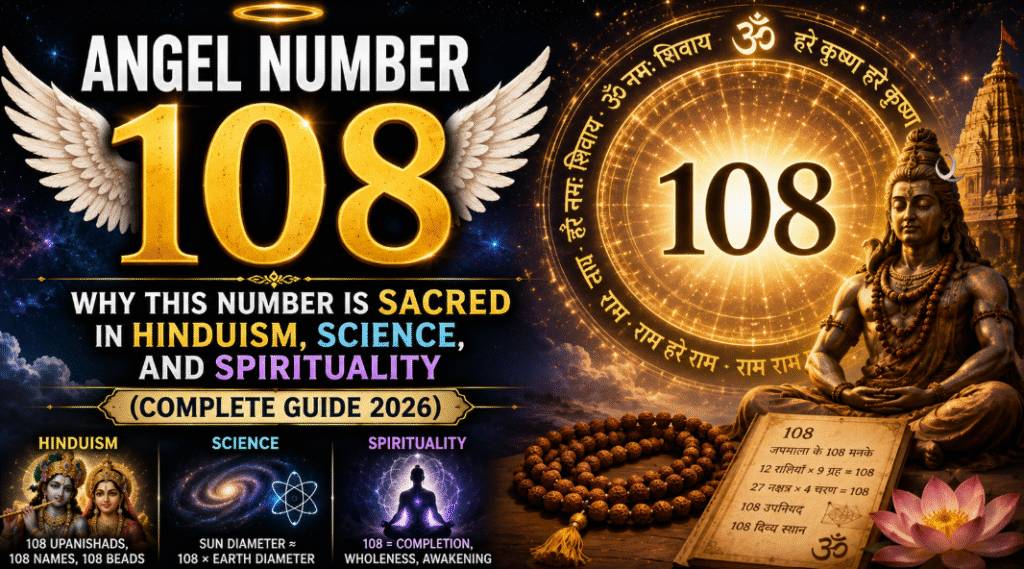
The Science of 108 — Mathematics and the Cosmos
Mathematics has its own reasons to find 108 special. In geometry, the interior angle of a regular pentagon is 108 degrees. The pentagon is the building block of the dodecahedron — one of the five Platonic solids that ancient Greek philosophers believed were the fundamental shapes of the universe.
In Vedic mathematics, 108 = 1 to the power 1 × 2 to the power 2 × 3 to the power 3 (1¹ × 2² × 3³ = 1 × 4 × 27 = 108). This elegant mathematical property — combining the first three integers each raised to their own power — is unique to 108 and has fascinated mathematicians for centuries.
The number also holds significance in physics and astronomy beyond the Earth-Sun-Moon ratios. The Sun’s diameter is roughly 108 times that of Earth itself, reinforcing the pattern at yet another scale.
What Does Angel Number 108 Mean Spiritually?
In numerological and angelic traditions, the meaning of 108 as an angel number is derived from its component digits:
1 — New beginnings, leadership, manifestation, and the power of intention. The number 1 is about stepping into your individual power.
0 — The infinite, the void, the divine source. Zero amplifies everything it stands beside and represents the continuous cycle of creation and dissolution.
8 — Abundance, karma, infinity (the sideways eight), and cosmic balance. The number 8 is about reaping what you sow, on both material and spiritual levels.
Together, 108 carries the message: You are beginning a new cycle (1), aligned with infinite divine source (0), and moving toward karmic completion and abundance (8). Seeing 108 repeatedly is often interpreted as a signal that you are on the right path — that the universe is acknowledging your spiritual journey.
Common Situations When People See 108
During or after prayer/meditation: A confirmation that your practice is landing, that you are truly connected.
At the start of a new project or life chapter: The universe signalling that this beginning is divinely supported.
After loss or grief: A gentle reminder of the cyclical nature of existence — that endings are also beginnings.
When considering a spiritual path or practice: An encouragement to go deeper — into Naam Jap, into bhakti, into whatever practice is calling you.
💡 If you keep seeing 108, try beginning a new discipline: 108 rounds of Naam Jap daily for 40 days. In Vedic tradition, 40 days is the minimum period for a new practice to create lasting change.
108 in Astrology — Vedic and Western
In Vedic astrology (Jyotish), 108 appears in the calculation of the Nakshatra system. There are 27 Nakshatras (lunar mansions), each divided into 4 padas (quarters). 27 × 4 = 108. The entire system of lunar Nakshatras that maps the sky in Vedic astrology is built on a foundation of 108 units.
In Western astrology, the 360-degree zodiac divides naturally by 108 in ways that produce important harmonic aspects. The trine aspect (120°) and the quintile (72°) together sum to 192, but the 108° angle itself — the biquintile — is considered a highly creative, spiritually charged aspect in modern astrological practice.
How to Work with Angel Number 108
If 108 is showing up in your life, here are meaningful ways to engage with its energy:
Mala Meditation: Acquire a 108-bead mala and begin a daily Naam Jap practice. Start with ‘Radhe Radhe’ or any divine name that resonates with you.
Set a 108-Day Intention: In many traditions, a 108-day sankalp (vow) is a powerful way to align with a new direction in life. Choose something meaningful and commit for 108 days.
Practise 108 Sun Salutations: In yoga, 108 Surya Namaskars done on the solstice or equinox is a time-honoured practice for clearing old energy and welcoming new cycles.
Write Your Gratitude 108 Times: Write a statement of gratitude — for Radha-Krishna’s grace, for life, for love — 108 times. This is a form of written Naam Jap with profound psychological and spiritual effect.
Frequently Asked Questions
Q: Is 108 specifically a Hindu number or is it universal?
A: Both. It originates strongly in the Vedic tradition, but its significance has been independently recognised across Buddhism, Islam, and Jainism, and it has geometric and astronomical properties that make it universally meaningful.
Q: I keep seeing 108 everywhere. Is something about to change?
A: Many spiritual traditions would say yes — seeing 108 repeatedly often accompanies periods of transition. The key is to stay present and open to new beginnings.
Q: Does 108 appear in Radha-Krishna devotion specifically?
A: Very much so. Both Radha and Krishna have 108 names (Ashtottara). The mala used in Vaishnava Naam Jap has 108 beads. In Pushti Marg and other Krishna traditions, 108 is woven into the very fabric of worship.
Q: What is the difference between angel number 108 and the sacred number 108 in Hinduism?
A: Angel numbers come from a Western New Age framework of numerology. The sacred number 108 in Hinduism has thousands of years of theological, astronomical, and mathematical grounding. They converge on the same number from different directions — which itself is worth contemplating.
Conclusion — When the Universe Uses a Number to Speak
Angel number 108 is more than a coincidence and more than a symbol. It is an invitation. It is the universe — or Krishna, or the divine, or whatever name you give to the intelligence behind existence — using the language of numbers to nudge you toward awareness, toward devotion, toward the next chapter of your journey.
In Hinduism, 108 is the sacred count of the cosmos. In mathematics, it is an elegant equation. In your daily life, it is a whisper from something greater than yourself, saying: you are seen, you are guided, keep going.
Explore 108-bead Naam Jap, the 108 names of Radha and Krishna, and daily devotional practice at radhajap.in — where every chant is a step deeper into the infinite.

I’m Ankita, and I love everything about Radha Krishna bhakti. Naam Jap is a daily part of my life, and Radhajap.in is my way of sharing that love and devotion with others.
Radha Krishna radhe Krishna Radha Krishna Radha Krishna Radha Krishna Radha Krishna Radha Krishna Radha Krishna Radha Krishna Radha Krishna Radha Krishna Radha Krishna Radha Krishna Radha Krishna Radha Krishna Radha Krishna Radha Krishna Radha Krishna Radha Krishna Radha Krishna Radha Krishna Radha Krishna Radha Krishna Radha Krishna Radha Krishna Radha Krishna Radha Krishna Radha Krishna Radha Krishna Radha Krishna Radha Krishna Radha Krishna Radha Krishna Radha Krishna Radha Krishna Radha Krishna Radha Krishna Radha Krishna Radha Krishna Radha Krishna Radha Krishna Radha Krishna Radha Krishna Radha Krishna Radha Krishna Radha Krishna Radha Krishna Radha Krishna Radha Krishna Radha Krishna Radha Krishna Radha Krishna Radha Krishna Radha Krishna Radha Krishna Radha Krishna Radha Krishna Radha Krishna Radha Krishna Radha Krishna Radha Krishna Radha Krishna Radha Krishna Radha Krishna Radha Krishna Radha Krishna Radha Krishna Radha Krishna Radha Krishna Radha Krishna Radha Krishna Radha Krishna Radha Krishna Radha Krishna Radha Krishna Radha Krishna Radha Krishna Radha Krishna Radha Krishna Radha Krishna Radha Krishna Radha Krishna Radha Krishna Radha Krishna Radha Krishna Radha Krishna Radha Krishna Radha Krishna Radha Krishna Radha Krishna Radha Krishna Radha Krishna Radha Krishna Radha Krishna Radha Krishna Radha Krishna Radha Krishna Radha Krishna Radha Krishna Radha Krishna Radha Krishna Radha Krishna Radha Krishna Radha Krishna Radha Krishna Radha Krishna Radha Krishna Radha Krishna Radha Krishna Radha Krishna Radha Krishna Radha Krishna Radha Krishna Radha Krishna Radha Krishna Radha Krishna Radha Krishna Radha Krishna Radha Krishna Radha Krishna Radha Krishna Radha Krishna Radha Krishna Radha Krishna Radha Krishna Radha Krishna Radha Krishna Radha Krishna Radha Krishna Radha Krishna Radha Krishna Radha Krishna Radha Krishna Radha Krishna Radha Krishna Radha Krishna Radha Krishna Radha Krishna Radha Krishna Radha Krishna Radha Krishna Radha Krishna Radha Krishna Radha Krishna Radha Krishna Radha Krishna Radha Krishna Radha Krishna Radha Krishna Radha Krishna Radha Krishna Radha Krishna Radha Krishna Radha Krishna Radha Krishna Radha Krishna Radha Krishna Radha Krishna Radha Krishna Radha Krishna Radha Krishna Radha Krishna Radha Krishna Radha Krishna Radha Krishna Radha Krishna Radha Krishna Radha Krishna Radha Krishna Radha Krishna Radha Krishna Radha Krishna Radha Krishna Radha Krishna Radha Krishna Radha Krishna Radha Krishna Radha Krishna Radha Krishna Radha Krishna Radha Krishna Radha Krishna Radha Krishna Radha Krishna Radha Krishna Radha Krishna Radha Krishna Radha Krishna Radha Krishna Radha Krishna Radha Krishna Radha Krishna Radha Krishna Radha Krishna Radha Krishna Radha Krishna Radha Krishna Radha Krishna Radha Krishna Radha Krishna Radha Krishna Radha Krishna Radha Krishna Radha Krishna Radha Krishna Radha Krishna Radha Krishna Radha Krishna Radha Krishna Radha Krishna Radha Krishna Radha Krishna Radha Krishna Radha Krishna Radha Krishna Radha Krishna Radha Krishna Radha Krishna Radha Krishna Radha Krishna Radha Krishna Radha Krishna Radha Krishna Radha Krishna Radha Krishna Radha Krishna Radha Krishna Radha Krishna Radha Krishna Radha Krishna Radha Krishna Radha Krishna Radha Krishna Radha Krishna Radha Krishna Radha Krishna Radha Krishna Radha Krishna Radha Krishna Radha Krishna Radha Krishna Radha Krishna Radha Krishna Radha Krishna Radha Krishna Radha Krishna Radha Krishna Radha Krishna Radha Krishna Radha Krishna Radha Krishna Radha Krishna Radha Krishna Radha Krishna Radha Krishna Radha Krishna Radha Krishna Radha Krishna Radha Krishna Radha Krishna Radha Krishna Radha Krishna Radha Krishna Radha Krishna Radha Krishna Radha Krishna Radha Krishna Radha Krishna Radha Krishna Radha Krishna Radha Krishna Radha Krishna Radha Krishna Radha Krishna Radha Krishna Radha Krishna Radha Krishna Radha Krishna Radha Krishna Radha Krishna Radha Krishna Radha Krishna Radha Krishna Radha Krishna Radha Krishna Radha Krishna Radha Krishna Radha Krishna Radha Krishna Radha Krishna Radha Krishna Radha Krishna Radha Krishna Radha Krishna Radha Krishna Radha Krishna Radha Krishna Radha Krishna Radha Krishna Radha Krishna Radha Krishna Radha Krishna Radha Krishna Radha Krishna Radha Krishna Radha Krishna Radha Krishna Radha Krishna Radha Krishna Radha Krishna Radha Krishna Radha Krishna Radha Krishna Radha Krishna Radha Krishna Radha Krishna Radha Krishna Radha Krishna Radha Krishna Radha Krishna Radha Krishna Radha Krishna Radha Krishna Radha Krishna Radha Krishna Radha Krishna Radha Krishna Radha Krishna Radha Krishna Radha Krishna Radha Krishna Radha Krishna Radha Krishna Radha Krishna Radha Krishna Radha Krishna Radha Krishna Radha Krishna Radha Krishna Radha Krishna Radha Krishna Radha Krishna Radha Krishna Radha Krishna Radha Krishna Radha Krishna Radha Krishna Radha Krishna Radha Krishna Radha Krishna Radha Krishna Radha Krishna Radha Krishna Radha Krishna Radha Krishna Radha Krishna Radha Krishna Radha Krishna Radha Krishna Radha Krishna Radha Krishna Radha Krishna Radha Krishna Radha Krishna Radha Krishna Radha Krishna Radha Krishna Radha Krishna Radha Krishna Radha Krishna Radha Krishna Radha Krishna Radha Krishna Radha Krishna Radha Krishna Radha Krishna Radha Krishna Radha Krishna Radha Krishna Radha Krishna Radha Krishna Radha Krishna Radha Krishna Radha Krishna Radha Krishna Radha Krishna Radha Krishna Radha Krishna Radha Krishna Radha Krishna Radha Krishna Radha Krishna Radha Krishna Radha Krishna Radha Krishna Radha Krishna Radha Krishna Radha Krishna Radha Krishna Radha Krishna Radha Krishna Radha Krishna Radha Krishna Radha Krishna Radha Krishna Radha Krishna Radha Krishna Radha Krishna Radha Krishna Radha Krishna Radha Krishna Radha Krishna Radha Krishna Radha Krishna Radha Krishna Radha Krishna Radha Krishna Radha Krishna Radha Krishna Radha Krishna Radha Krishna Radha Krishna Radha Krishna Radha Krishna Radha Krishna Radha Krishna Radha Krishna Radha Krishna Radha Krishna Radha Krishna Radha Krishna Radha Krishna Radha Krishna Radha Krishna Radha Krishna Radha Krishna Radha Krishna Radha Krishna Radha Krishna Radha Krishna Radha Krishna Radha Krishna Radha Krishna Radha Krishna Radha Krishna Radha Krishna Radha Krishna Radha Krishna Radha Krishna Radha Krishna Radha Krishna Radha Krishna Radha Krishna Radha Krishna Radha Krishna Radha Krishna Radha Krishna Radha Krishna Radha Krishna Radha Krishna Radha Krishna Radha Krishna Radha Krishna Radha Krishna Radha Krishna Radha Krishna Radha Krishna Radha Krishna Radha Krishna Radha Krishna Radha Krishna Radha Krishna Radha Krishna Radha Krishna Radha Krishna Radha Krishna Radha Krishna Radha Krishna Radha Krishna Radha Krishna Radha Krishna Radha Krishna Radha Krishna Radha Krishna Radha Krishna Radha Krishna Radha Krishna Radha Krishna Radha Krishna Radha Krishna Radha Krishna Radha Krishna Radha Krishna Radha Krishna Radha Krishna Radha Krishna Radha Krishna Radha Krishna Radha Krishna Radha Krishna Radha Krishna Radha Krishna Radha Krishna Radha Krishna Radha Krishna Radha Krishna Radha Krishna Radha Krishna Radha Krishna Radha Krishna Radha Krishna Radha Krishna Radha Krishna Radha Krishna Radha Krishna Radha Krishna Radha Krishna Radha Krishna Radha Krishna Radha Krishna Radha Krishna Radha Krishna Radha Krishna Radha Krishna Radha Krishna Radha Krishna Radha Krishna Radha Krishna Radha Krishna Radha Krishna Radha Krishna Radha Krishna Radha Krishna Radha Krishna Radha Krishna Radha Krishna Radha Krishna Radha Krishna Radha Krishna Radha Krishna Radha Krishna Radha Krishna Radha Krishna Radha Krishna Radha Krishna Radha Krishna Radha Krishna Radha Krishna Radha Krishna Radha Krishna Radha Krishna Radha Krishna Radha Krishna Radha Krishna Radha Krishna Radha Krishna Radha Krishna Radha Krishna Radha Krishna Radha Krishna Radha Krishna Radha Krishna Radha Krishna Radha Krishna Radha Krishna Radha Krishna Radha Krishna Radha Krishna Radha Krishna Radha Krishna Radha Krishna Radha Krishna Radha Krishna Radha Krishna Radha Krishna Radha Krishna Radha Krishna Radha Krishna Radha Krishna Radha Krishna Radha Krishna Radha Krishna Radha Krishna Radha Krishna Radha Krishna Radha Krishna Radha Krishna Radha Krishna Radha Krishna Radha Krishna Radha Krishna Radha Krishna Radha Krishna Radha Krishna Radha Krishna Radha Krishna Radha Krishna Radha Krishna Radha Krishna Radha Krishna Radha Krishna Radha Krishna Radha Krishna Radha Krishna Radha Krishna Radha Krishna Radha Krishna Radha Krishna Radha Krishna Radha Krishna Radha Krishna Radha Krishna Radha Krishna Radha Krishna Radha Krishna Radha Krishna Radha Krishna Radha Krishna Radha Krishna Radha Krishna Radha Krishna Radha Krishna Radha Krishna Radha Krishna Radha Krishna Radha Krishna Radha Krishna Radha Krishna Radha Krishna Radha Krishna Radha Krishna Radha Krishna Radha Krishna Radha Krishna Radha Krishna Radha Krishna Radha Krishna Radha Krishna Radha Krishna Radha Krishna Radha Krishna Radha Krishna Radha Krishna Radha Krishna Radha Krishna Radha Krishna Radha Krishna Radha Krishna Radha Krishna Radha Krishna Radha Krishna Radha Krishna Radha Krishna Radha Krishna Radha Krishna Radha Krishna Radha Krishna Radha Krishna Radha Krishna Radha Krishna Radha Krishna Radha Krishna Radha Krishna Radha Krishna Radha Krishna Radha Krishna Radha Krishna Radha Krishna Radha Krishna Radha Krishna Radha Krishna Radha Krishna Radha Krishna Radha Krishna Radha Krishna Radha Krishna Radha Krishna Radha Krishna Radha Krishna Radha Krishna Radha Krishna Radha Krishna Radha Krishna Radha Krishna Radha Krishna Radha Krishna Radha Krishna Radha Krishna Radha Krishna Radha Krishna Radha Krishna Radha Krishna Radha Krishna Radha Krishna Radha Krishna Radha Krishna Radha Krishna Radha Krishna Radha Krishna Radha Krishna Radha Krishna Radha Krishna Radha Krishna Radha Krishna Radha Krishna Radha Krishna Radha Krishna Radha Krishna Radha Krishna Radha Krishna Radha Krishna Radha Krishna Radha Krishna Radha Krishna Radha Krishna Radha Krishna Radha Krishna Radha Krishna Radha Krishna Radha Krishna Radha Krishna Radha Krishna Radha Krishna Radha Krishna Radha Krishna Radha Krishna Radha Krishna Radha Krishna Radha Krishna Radha Krishna Radha Krishna Radha Krishna Radha Krishna Radha Krishna Radha Krishna Radha Krishna Radha Krishna Radha Krishna Radha Krishna Radha Krishna Radha Krishna Radha Krishna Radha Krishna Radha Krishna Radha Krishna Radha Krishna Radha Krishna Radha Krishna Radha Krishna Radha Krishna Radha Krishna Radha Krishna Radha Krishna Radha Krishna Radha Krishna Radha Krishna Radha Krishna Radha Krishna Radha Krishna Radha Krishna Radha Krishna Radha Krishna Radha Krishna Radha Krishna Radha Krishna Radha Krishna Radha Krishna Radha Krishna Radha Krishna Radha Krishna Radha Krishna Radha Krishna Radha Krishna Radha Krishna Radha Krishna