
Scroll through spiritual content on Instagram or YouTube in 2026 and you will increasingly notice something unexpected: young Indians — millennials and Gen Z — are not just watching lo-fi Vedanta clips or following neo-spirituality influencers. A growing number are talking about Pushti Marg, learning about Srinathji, attending Haveli sangeet sessions, and diving deep into a tradition that is nearly 500 years old.
So what exactly is Pushti Marg? And why is this ancient Vaishnava tradition suddenly resonating with a generation that grew up on Netflix and memes?
Pushti Marg — The Path of Grace, Not Effort
Pushti Marg, which translates to ‘The Path of Nourishment’ or ‘The Path of Grace,’ is a devotional tradition founded by the great philosopher-saint Vallabhacharya (1479–1531 CE) in the Braj region of northern India.
Unlike many other spiritual paths that emphasise rigorous sadhana, austerity, and self-effort, Pushti Marg is founded on a radical idea: the grace of Krishna (called ‘Pushti’ — divine nourishment) is not earned. It is freely given by Krishna to those He chooses, out of His own infinite love.
In Vallabhacharya’s philosophy, the human soul (jeev) is inherently a part of Krishna — a spark of His divine essence. The goal of life is not liberation from the world (Moksha in the traditional sense) but the eternal, blissful service of Krishna in Golok — His divine abode.
Who Was Vallabhacharya?
Vallabhacharya was born in 1479 CE in Champaranya (in present-day Chhattisgarh) to a Telugu Brahmin family. He was a child prodigy who had mastered all four Vedas and the major Upanishads by the age of eleven. But his philosophical and devotional genius truly blossomed when he received a divine command from Krishna Himself at Govardhan Hill — a command to reveal the path of Pushti Bhakti to the world.
He articulated this philosophy in his key texts — Anubhashya (his commentary on the Brahma Sutras), Subodhini (commentary on the Bhagavata Purana), and the Shodasha Granthas (sixteen short but profound texts). His theology, known as Shuddhadvaita (Pure Non-Dualism), holds that the world is real and is the direct manifestation of Krishna — not an illusion (Maya) as proposed by Adi Shankaracharya.
The Core Philosophy — Shuddhadvaita
In Advaita Vedanta (Shankaracharya’s school), the world is considered an illusion (Maya) and the goal is to realise that the individual self and Brahman are identical. Vallabhacharya disagreed. In Shuddhadvaita:
The world is real: It is Krishna’s divine play (Leela) manifested in form. The rivers, trees, mountains, and humans — all are real expressions of Krishna’s bliss.
The soul is a part of Krishna: Not identical with Him, but genuinely a part — like a spark is part of fire. This relationship is eternal.
Bhakti is the highest path: Not knowledge (Jnana) or renunciation (Vairagya), but pure, selfless love of Krishna — this is the ultimate means and the ultimate goal.
Grace is supreme: Human effort alone cannot bring one to Krishna. It is His grace — Pushti — that lifts the devotee. The devotee’s role is simply to make themselves available to that grace through surrender and love.
Seva — The Heart of Pushti Marg Practice
The most distinctive aspect of Pushti Marg is its form of worship, called Seva — which literally means ‘service.’ But this is no ordinary ritual worship.
In Pushti Marg, Krishna (worshipped primarily as Shrinathji, a form of Bal Gopal — infant Krishna — at Nathdwara in Rajasthan) is not treated as a distant deity but as a living family member. Devotees wake Him in the morning, dress Him, offer Him meals throughout the day, entertain Him with music, put Him to nap in the afternoon, and put Him to bed at night.
This daily schedule of eight darshans (called Ashta Yam Seva) mirrors the intimate care a family gives a beloved child. The theology here is profound: you are not worshipping Krishna, you are loving Him. You are not performing a ritual — you are living in relationship.
💡 Shrinathji temple at Nathdwara, Rajasthan is the central pilgrimage site for Pushti Marg devotees. The darshan timings and the specific form of Seva performed there have remained largely unchanged for over 400 years.
Haveli Sangeet — Music as Devotion
One of the most exquisite gifts of Pushti Marg to Indian culture is Haveli Sangeet — the classical devotional music tradition developed specifically for Krishna’s Seva in the Haveli (temple-home).
Unlike the ecstatic kirtan of many Bhakti traditions, Haveli Sangeet is subtle, intimate, and highly classical. It uses specific ragas for specific times of day — Bhairav at dawn, Yaman in the evening — and specific seasons. Compositions called Padas, written by the Ashtachhap poets (eight poet-saints close to Vallabhacharya and his son Vitthalanatha), form the backbone of this tradition.
Today, Haveli Sangeet is gaining recognition not just as spiritual music but as a distinct classical genre — one that young musicians and listeners are rediscovering with fresh appreciation.
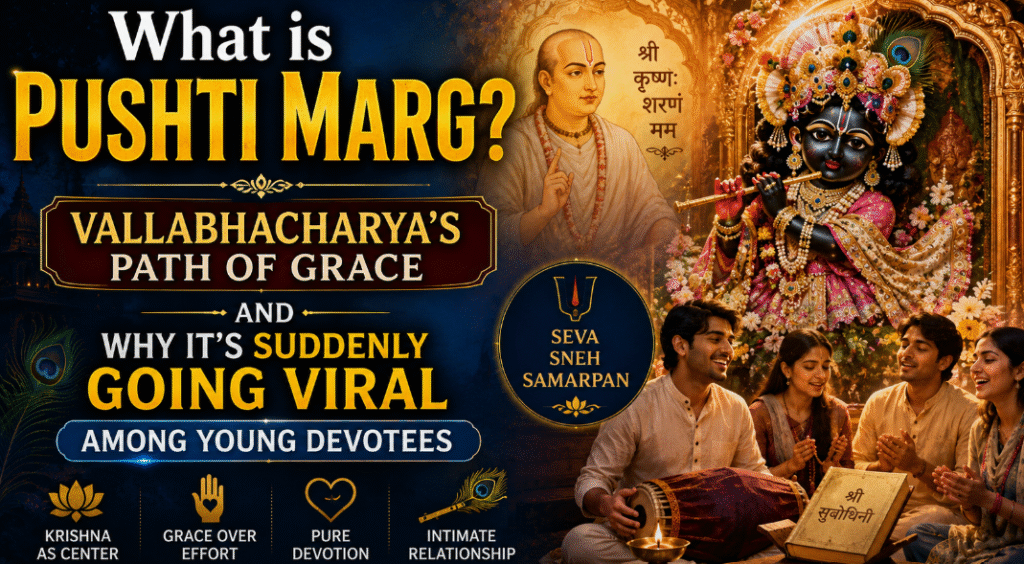
Why Is Pushti Marg Going Viral Among Young Devotees?
There are several reasons Pushti Marg is finding new life among India’s youth in 2026:
1. A Theology of Joy, Not Fear: Many young people have drifted away from religion because it felt transactional or fear-based. Pushti Marg offers the opposite — a path of pure love and joy, where devotion is not a duty but a delight.
2. Aesthetic Depth: From the beautifully dressed Shrinathji swaroops to the intricate Pichwai paintings to the exquisite Haveli Sangeet — Pushti Marg is visually and aesthetically one of the richest traditions in Hinduism. This visual and auditory depth speaks powerfully to a generation raised on design and music.
3. Accessibility: Thanks to platforms like radhajap.in and several YouTube channels, Pushti Marg philosophy, kirtans, and seva practices are now accessible to anyone with a smartphone — no physical temple required to begin.
4. Philosophical Rigour: Young intellectuals who find shallow spirituality unsatisfying are drawn to the depth of Vallabhacharya’s Shuddhadvaita. It can hold its own in any philosophical conversation.
5. Community: Pushti Marg has always been a family-centred tradition. Its emphasis on the Haveli as a home, on collective seva, on festivals celebrated with deep personal involvement — this sense of belonging is something many young people are actively seeking.
Pushti Marg vs Other Vaishnava Traditions
Pushti Marg vs ISKCON (Hare Krishna): Both are Vaishnava and centred on Krishna, but ISKCON follows the Gaudiya tradition of Chaitanya Mahaprabhu, with emphasis on public kirtan, renunciation, and guru-disciple initiation. Pushti Marg is more family-oriented, intimate, and focused on private home Seva.
Pushti Marg vs Ramanuja’s Vishishtadvaita: Both are non-dualist. But Vishishtadvaita emphasises Vishnu/Lakshmi and formal ritual worship (Agamic tradition). Pushti Marg is entirely centred on Krishna and uses intimate, domestic Seva rather than temple rituals.
How to Begin on the Path of Pushti Marg
You do not need to travel to Nathdwara to begin. You do not need elaborate rituals or initiation to start exploring. Here is how many modern devotees begin:
Listen: Start with Haveli Sangeet and Pushti Marg kirtans. Let the music open the door.
Read: Explore Vallabhacharya’s Shodasha Granthas or accessible commentaries on Shuddhadvaita philosophy.
Practice: Set up a small place for Krishna’s image or murti at home. Offer Him what you eat. Talk to Him. Treat Him as present.
Connect: Visit radhajap.in for daily devotional content, Naam Jap, and community connection.
Frequently Asked Questions
Q: Is Pushti Marg a sect or a mainstream Hindu practice?
A: Pushti Marg is a distinct Vaishnava sampradaya (tradition) within Hinduism — not a sect in a divisive sense. It coexists beautifully with broader Hindu practice. Millions of families in Gujarat and Rajasthan follow it as their primary devotional tradition.
Q: Do I need to be from a specific caste or community to follow Pushti Marg?
A: Vallabhacharya’s teachings were inclusive. While historically the tradition has been strong in certain Gujarati and Rajasthani communities, the philosophy of divine grace recognises no caste. Grace falls on whoever Krishna chooses.
Q: What is the difference between a Mahaprabhu and a Goswami in Pushti Marg?
A: ‘Mahaprabhu’ refers to Vallabhacharya himself, revered as an incarnation of Krishna’s grace. ‘Goswamis’ are the descendants of Vallabhacharya’s lineage who carry on the tradition and are the custodians of Seva at various Havelis.
Conclusion — A 500-Year-Old Tradition for a Restless Age
In an age of spiritual uncertainty, performance anxiety, and the exhausting chase for self-improvement, Pushti Marg offers a radical alternative: stop earning grace. Just love. Just serve. Just be available.
Vallabhacharya’s message, articulated in the 16th century, could not be more relevant today: you do not have to become worthy of Krishna’s love. You already are. The path is simply to open your heart and let that love flow — in seva, in song, in the quiet repetition of His name.Explore Pushti Marg, its music, its philosophy, and its gentle daily practices at radhajap.in — your companion on the path of grace.

I’m Ankita, and I love everything about Radha Krishna bhakti. Naam Jap is a daily part of my life, and Radhajap.in is my way of sharing that love and devotion with others.