
Every year, on the second day of Shukla Paksha in the month of Ashadha, one of the most magnificent spiritual spectacles on earth takes place in Puri, Odisha. Millions of devotees — from simple village folk to international pilgrims — gather on the Grand Road (Bada Danda) to catch a glimpse of Lord Jagannath, His sister Subhadra, and His brother Balabhadra as they ride their massive wooden chariots toward the Gundicha Temple. This is the Rath Yatra — the Festival of Chariots — and in 2026, it carries a spiritual energy that every devotee of Radha Krishna must understand.
Whether you are in Puri physically, watching it live online, or simply holding space in your heart from your home mandir, this complete guide will help you connect with the deep meaning, sacred traditions, and the profound Krishna-Radha dimension of Rath Yatra 2026.
Rath Yatra 2026 — Date and Tithi
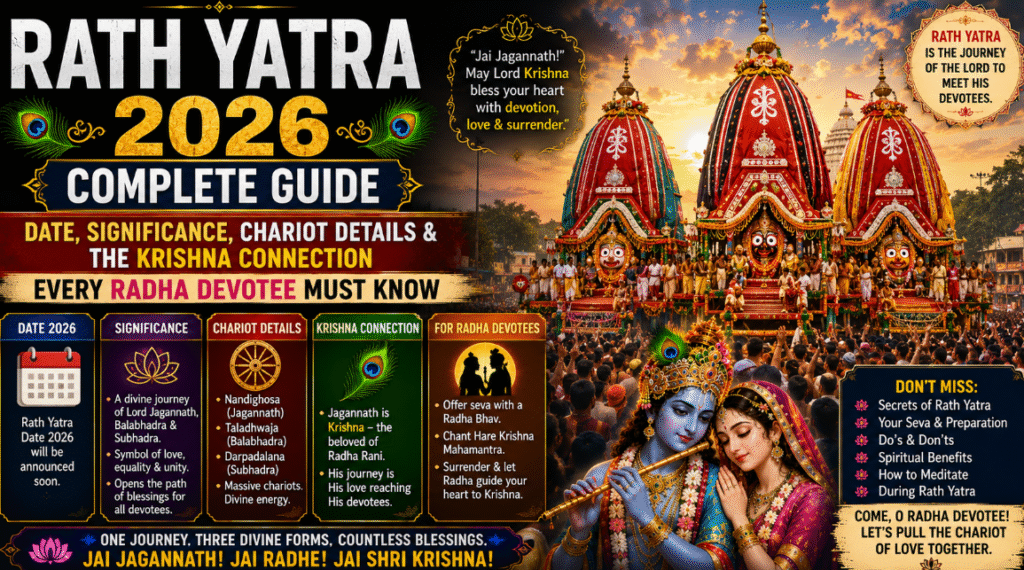
Rath Yatra 2026 falls on Sunday, 28 June 2026. The tithi is Ashadha Shukla Dwitiya (the second day of the bright fortnight in the month of Ashadha). The festival follows the Hindu lunar calendar and the date varies slightly each year depending on the nakshatra and panchang calculations of the Puri temple authorities.
Key dates to mark in your calendar:
- Snana Yatra (ritual bathing of the deities) — approximately 15 days before Rath Yatra
- Rath Yatra (Chariot Procession to Gundicha Temple) — 28 June 2026
- Hera Panchami — 5 days after Rath Yatra (Goddess Lakshmi searches for Lord Jagannath)
- Bahuda Yatra (Return Chariot Procession) — 9 days after Rath Yatra, approximately 7 July 2026
- Suna Besha (Golden Attire) — on the day of return, the deities are dressed in gold ornaments
Note: For precise Panchang-confirmed dates, always verify with the official Jagannath Temple Trust or a trusted Puri Panchang for 2026, as times can vary by a day based on tithi calculations.
The History and Origin of Rath Yatra
The Rath Yatra of Puri is believed to be at least 2,000 years old, though some scholars place its origins even earlier. The primary scriptural basis comes from the Skanda Purana, Brahma Purana, and Padma Purana, all of which describe the significance of witnessing or participating in the Chariot Festival at Puri (referred to as Purushottama Kshetra in the texts).
According to the most beloved tradition, the Rath Yatra commemorates Lord Krishna’s journey from Kurukshetra back to Vrindavan. After years of ruling Dwarka and fulfilling his royal and cosmic duties, the Gopis (milkmaids of Vrindavan) — led by their eternal queen Radha — had the opportunity to see Krishna at Kurukshetra during a solar eclipse. In that sacred moment, Radha pulls Krishna’s chariot by sheer force of her love and yearning, drawing him back toward Vrindavan — back toward pure bhakti, away from the world of duty and war.
This is the hidden story within the Rath Yatra. It is not merely a procession. It is a cosmic re-enactment of the power of Radha’s love to draw even the Supreme Lord toward herself. When you pull the ropes of the chariot, you are, in a mystical sense, doing what Radha did at Kurukshetra — pulling Krishna back to your heart.
The Three Chariots — Nandighosa, Taladhwaja, and Devadalan
The three chariots built for the Rath Yatra are among the most elaborate wooden structures constructed annually anywhere in the world. They are built fresh each year by skilled craftsmen (Maharanas) using specific types of wood, following precise measurements laid down in ancient texts.
Nandighosa — Lord Jagannath’s Chariot
This is the largest and most iconic of the three chariots, belonging to Lord Jagannath (a form of Krishna). Key features include:
- Height: approximately 45 feet (around 13.5 meters)
- Wheels: 16 wheels, each about 7 feet in diameter
- Color scheme: Red and yellow canopy with yellow and red flags
- Flag (Dhwaja): Trailokyamohini (Enchanter of the Three Worlds)
- Protector deity: Garuda (the divine eagle and vehicle of Vishnu)
- Number of horses: 4 (white) named Sankha, Balahaka, Shweta, and Haridashwa
- Charioteer: Daruka (the eternal charioteer of Lord Krishna in the Puranas)
The rope used to pull Nandighosa is called Shankhachuda Naga. Millions of devotees consider it the greatest fortune to touch or pull this rope even once in their lifetime.
Taladhwaja — Lord Balabhadra’s Chariot
This chariot belongs to Balabhadra (Balarama), elder brother of Krishna:
- Height: approximately 44 feet
- Wheels: 14 wheels
- Color scheme: Red and blue/black canopy
- Flag: Unnani
- Protector deity: Vasudeva
Devadalan — Goddess Subhadra’s Chariot
This chariot belongs to Subhadra, sister of Krishna and Balarama:
- Height: approximately 43 feet
- Wheels: 12 wheels
- Color scheme: Red and black canopy with a red flag
- Flag: Nadambika
- Protector deity: Jayadurga
The order of procession is: Taladhwaja first, then Devadalan, then Nandighosa last. This is because the elder brother Balabhadra leads the way, making the path auspicious for the Lord.
The Gundicha Temple — The Destination of the Lord’s Heart
The chariots travel approximately 3 kilometers along the Bada Danda (Grand Road) to reach the Gundicha Temple. According to tradition, Gundicha Ghar represents Vrindavan — the original home of Krishna’s heart. The Lord stays at the Gundicha Temple for 7 to 9 days, during which time devotees can have a different kind of darshan — Lord Jagannath is considered more accessible and more intimate at Gundicha than at the main temple. This period is called the ‘Adapa Darshan’ (the darshan without ceremony), and tradition says that during these days, Lord Jagannath accepts the prayers of even the most lowly and fallen souls without distinction.
For Radha devotees, this detail is especially meaningful. Vrindavan (Gundicha) is the land of unconditional love — where the Lord sets aside his cosmic majesty and simply is. Just as Krishna in Vrindavan was not the king of Dwarka or the hero of Kurukshetra but simply the beloved of Radha, at the Gundicha Temple he is simply Lord Jagannath — the Lord of the Universe who weeps tears of love from his giant eyes for every single soul who calls his name.
The Radha Connection — Why Radha Devotees Must Observe Rath Yatra
Many devotees of Radha Krishna sometimes wonder: Rath Yatra is about Jagannath, not specifically Radha-Krishna — so should it matter to me? The answer is a profound yes, for several reasons.
First, Jagannath is universally accepted as a form of Krishna. The massive round eyes of Jagannath are said to represent the same eyes that looked upon Radha in Vrindavan with infinite love. Bhakti acharyas have written extensively about how Jagannath’s form (without distinct hands and feet, with large eyes and a wide smile) reflects the state Krishna was in when a Gopi brought him news of Radha — he was so overcome with love that his limbs merged into his body and only his eyes and smile remained. This ecstatic form is Jagannath.
Second, the Rath Yatra itself commemorates the Gopis pulling Krishna’s chariot at Kurukshetra — an act led by Radha herself. Every pull of the chariot rope is a devotional echo of Radha’s love. When you participate in or observe Rath Yatra with this understanding, the entire festival becomes a Radha bhakti event.
Third, many Vaishnava traditions observe a special puja to Radha Rani on Rath Yatra day, praying that just as Radha brought Krishna back to Vrindavan through her love, so too may the Lord’s grace bring our hearts back to the feet of Radha.
How to Celebrate Rath Yatra 2026 at Home
If you cannot travel to Puri or another major Rath Yatra location, here are meaningful ways to participate from home:
- Wake up before sunrise, bathe, and light a lamp at your home altar
- Offer yellow flowers, yellow sweets (particularly rice kheer or chenna poda), and tulsi to the Lord
- Chant the Hare Krishna Mahamantra 108 times on your mala
- Read or listen to the Rath Yatra chapters from Srimad Bhagavatam or Skanda Purana
- Watch the Puri Rath Yatra live — Doordarshan and many YouTube channels stream it live
- Sing or play Jagannath bhajans throughout the day
- Feed children, the elderly, or the poor — as prasad distribution is central to Rath Yatra
- Draw or print a small chariot image and place it on your altar as a symbol of the Lord’s procession
Rath Yatra Across India and the World in 2026
While the Puri Rath Yatra is the most famous, the festival is celebrated in hundreds of cities across India and internationally:
- Ahmedabad, Gujarat: One of India’s largest Rath Yatras outside Puri, drawing over a million devotees
- Vrindavan and Mathura: Sacred Braj celebrations with a strong Radha-Krishna emphasis
- ISKCON temples worldwide: From New York to London to Sydney, ISKCON conducts elaborate Rath Yatras in major cities on or near the Ashadha Dwitiya date
- Kolkata: The city has a rich Rath Yatra tradition in many neighborhoods
Spiritual Benefits of Observing Rath Yatra
The Puranas are generous in describing the spiritual merit of Rath Yatra participation. The Brahma Purana states that even seeing the chariot from a distance, even from a rooftop, earns liberation from countless births. The Skanda Purana says that pulling the ropes of the chariot — even for a single step — is equivalent to performing a hundred Ashwamedha yagnas. And the Padma Purana declares that receiving the Lord’s prasad on Rath Yatra day cleanses a person of all karmic debts accumulated over seven lifetimes.
Beyond the scriptural promises, countless devotees across centuries have experienced something very simple and very real on Rath Yatra day: a feeling that the Lord has come out to meet them. That the wall between the devotee and the Divine has, for one extraordinary day, been rolled away like the great canopy of the chariot. That Krishna, in His most loving form, is rolling toward you — and all you need to do is stand by the road and receive his grace.
A Prayer for Rath Yatra 2026
“O Jagannath, Lord of the Universe, You who are Krishna in the form of eternal longing — may Your chariot roll through the streets of my heart. May the ropes of Your love pull me toward Vrindavan. May I stand at the side of the road with Radha, and may my tears, like Hers, be tears not of sorrow but of the unspeakable joy of seeing Your face.”
Jai Jagannath! Jai Shri Radhe! Radhe Radhe.
Radha Krishna bhakti has always been the center of my life, and that’s why I founded Radhajap.in. I’m Vikas, and I believe in the divine power of Naam Jap to transform hearts and bring us closer to Radha Krishna. Through Radhajap.in, I aim to inspire every devotee to embrace a life filled with love, devotion, and the bliss of chanting.