
Picture this: A group of young pilgrims arrives at the sacred ghats of Vrindavan. The sun is rising, the Yamuna shimmers in soft golden light, and temple bells echo across the water. But before folding their hands in prayer, three of them pull out their phones — one adjusts the ring light, another searches for the perfect filter, and a third records a reel saying, “Day 1 of my spiritual journey — Radhe Radhe!” with trending Bollywood audio in the background.
This is not a fictional scene. It plays out at Mathura, Barsana, Govardhan, Tirupati, and practically every major Hindu pilgrimage site in India, every single day.
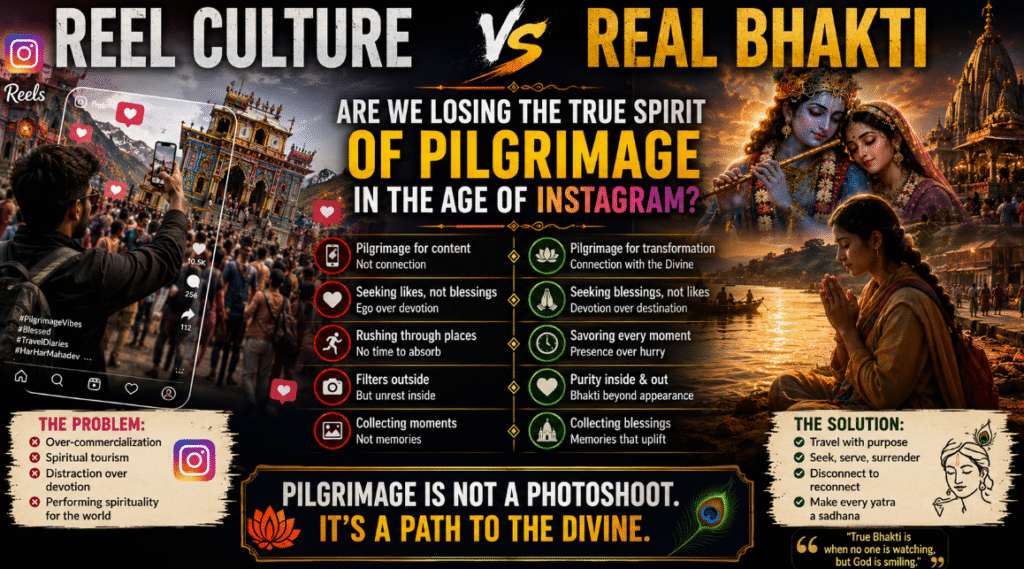
And it raises a question that many senior devotees and spiritual seekers are quietly — and sometimes very loudly — asking: Are we losing the true soul of yatra in the pursuit of social media validation?
What Does “Real Bhakti” in a Pilgrimage Actually Mean?
The word yatra does not simply mean a religious trip. In the Vaishnava tradition — and across all major sampradayas — a pilgrimage is a complete surrender of the self. You leave your comfort, your ego, and your identity at home. You arrive at a sacred kshetra as a humble seeker, not as a tourist, and certainly not as a content creator.
The Skanda Purana and Padma Purana both describe the transformative power of tirth yatra — the idea that merely arriving at a holy place with a pure, surrendered heart destroys lifetimes of accumulated karma. The emphasis has always been on antarmukhi bhav — an inward-turning awareness, not an outward performance.
Real bhakti during pilgrimage looks like:
- Walking the Govardhan Parikrama barefoot in complete silence and naam jap
- Sitting by the Yamuna at dawn and weeping spontaneously before Shri Radha
- Performing Barsana’s Lathmar Holi not for the camera, but to feel a fraction of the divine leela
- Offering just a single marigold flower at a deity’s feet with full-hearted devotion
- Listening to an old saint’s katha and letting it crack open something inside you
The Rise of Reel Culture at Sacred Sites: What’s Really Happening?
In 2024 and 2025, India saw an extraordinary surge in pilgrimage tourism. Kedarnath, Vrindavan, Tirupati, and Ayodhya each witnessed record-breaking footfall. The Ram Mandir consecration in Ayodhya alone attracted over 5 crore pilgrims in the first few months. Social media played a major role in this.
Instagram and YouTube are flooded with content tagged #VrindavanVibes, #KedarnathDiaries, and #SpiritualJourney. And yes — some of this content is beautiful, informative, and genuinely devotional. It has drawn millions of young Indians toward their own sacred heritage.
But there is a shadow side.
Many pilgrims now plan their yatra around what will look best on camera. Darshan becomes a backdrop. Prasad becomes a prop. The aarti at Yamuna Ghat is framed, filmed, and posted — but was it felt? Sacred Holi colours at Barsana are worn for aesthetics, not for Radha Rani’s love.
There are reported incidents of pilgrims cutting queues to get better photo angles at temples. At some ghats, the sacred space is now littered with ring light tripods. Elderly devotees have spoken about the impossibility of meditating during aarti when young visitors are jostling for video positions.
The Real Problem: When Performance Replaces Presence
The Bhagavata Purana teaches that Bhakti requires ananya bhav — undivided, singular devotion. The mind that is calculating angles for a reel cannot simultaneously dissolve into Hari Naam. It is not possible.
Spiritually, this is a profound crisis. When you replace presence with performance, you return from Vrindavan not transformed — but tired, with 300 new followers.
The deeper issue is the psychology of validation-seeking. A genuine pilgrimage builds inner fullness — a quiet confidence that comes from surrendering to something greater than yourself. Social media, by design, feeds on external validation. The two motivations are fundamentally opposite.
Is Social Media All Bad? A Fair Look at Both Sides
It would be unfair — and untrue — to say that all social media sharing from sacred spaces is corrupt. There are devotees who share pilgrimage content with genuine intention:
- Creating detailed guides that help first-time pilgrims navigate Char Dham or Vrindavan
- Sharing Bhajans and Naam Jap recordings that bring distant devotees to tears
- Documenting rare festivals like Radhashtami celebrations in Barsana that would otherwise go unseen
- Inspiring non-practicing Hindus to reconnect with their spiritual roots
The question is not whether to document — but when and how. There is a profound difference between someone who completes their darshan, sits quietly in prayer for an hour, and then takes a single photograph to share with a devotional caption — versus someone who spends the darshan hour shooting content.
How to Reclaim the True Spirit of Pilgrimage in 2026
Here are some practical, spiritually-grounded ways to go on yatra and return genuinely transformed:
1. Practice a ‘Phone Curfew’ at Sacred Spaces
Decide before your yatra that you will keep your phone in your bag during all darshan, parikrama, aarti, and katha sessions. Take photographs only after the spiritual experience is complete — not during. This single decision will transform your pilgrimage.
2. Set an Intention Before You Arrive
Write down — physically, with pen and paper — one sincere prayer or intention for your yatra. What are you truly seeking? Grace? Healing? Surrender? Read this every morning of your pilgrimage. Let it anchor you when the crowd noise and phone temptations begin.
3. Do Naam Jap Instead of Scrolling
Every minute you spend on your phone during yatra is a minute your mind is not in the divine atmosphere of the kshetra. Replace that habit with continuous naam jap — Radhe Radhe, Hare Krishna, or whichever naam resonates with your heart. You will feel the difference by Day 2.
4. Seek Out Local Sadhus and Saints
Most pilgrims visit the famous temples and rush home. The real jewels of a pilgrimage are the quiet saints sitting under trees, the old widows doing continuous Radha Naam, the priests who will share a story that breaks your heart open. Seek them out. Sit with them. Listen.
A Special Message to Devotee Content Creators
If you are someone who makes pilgrimage content — and does so with a devotional heart — this article is not against you. In fact, you have a sacred responsibility. Your content can either pull people toward genuine bhakti or teach them to perform it.
Share what you felt, not just what you filmed. Talk about the moment when a bhajan moved you to tears, not just the reel that went viral. Teach your audience to turn inward. That is dharmic content creation — and the digital age desperately needs it.
What the Vedic Tradition Says About Inner vs Outer Pilgrimage
In the Mahabharata, Vidura says to Yudhishthira: “He who has controlled his mind, who is free from pride and harsh speech, who is compassionate — he has made all the tirthas.” The outer pilgrimage mirrors and supports the inner one — but it cannot replace it.
Bhakti Ratnakara and the writings of Goswami Tulasidas both emphasize that a yatra done with ego, show-off, or desire for praise earns no spiritual merit. The pilgrimage must be done in a spirit of dainya — humility — and akinchanta — complete emptying of self.
Frequently Asked Questions (FAQ)
Q: Is it wrong to take photos at temples and pilgrimage sites?
A: Photography itself is not wrong. The problem arises when the pursuit of content replaces genuine devotion. Complete your darshan and prayers first, then photograph mindfully. Many temples now have photography-free zones near the main deity — always respect these.
Q: Can a yatra done for tourism still be spiritually beneficial?
A: Yes — even an accidental visit to a holy kshetra leaves subtle impressions (samskaras) on the soul. But the fruits are multiplied manifold when you go with even a small amount of sincere intention and surrender.
Q: How can I protect my devotional mindset in a crowd of phone-wielding pilgrims?
A: Continuous naam jap is your shield. When your mouth and mind are absorbed in Radhe Radhe or Hare Krishna, external disturbances lose their power over your inner state. Carry mala beads and keep chanting.
Q: What is the right way to share pilgrimage experiences on social media?
A: Share what genuinely moved you. Describe the experience emotionally and spiritually, not just visually. Avoid posting during the yatra itself if you can. Create content after you return, when your heart is still full and your words carry the fragrance of the sacred place.
Conclusion: The Pilgrimage That Truly Changes You
Vrindavan, Kedarnath, Barsana, Mathura — these are not exotic travel destinations. They are living, breathing sacred energies that respond to sincere hearts. They have transformed hardened criminals into saints, and broken-hearted people into radiant devotees.
But this transformation requires one thing above all: you must be present. Fully, completely, un-distractedly present.
Put down the phone. Let the Yamuna’s scent fill your lungs. Let the aarti flame touch your eyes and burn something away. Let Radha Rani’s name rise from your throat without calculating how it sounds in a reel.
Come back not with viral content — come back changed. That is the true meaning of yatra.
Radhe Radhe 🙏
Radha Krishna bhakti has always been the center of my life, and that’s why I founded Radhajap.in. I’m Vikas, and I believe in the divine power of Naam Jap to transform hearts and bring us closer to Radha Krishna. Through Radhajap.in, I aim to inspire every devotee to embrace a life filled with love, devotion, and the bliss of chanting.